Marine lubricants are not interchangeable with automotive oils, and the cost of getting it wrong in an outboard or a marine engine is real: a voided warranty, a damaged lower unit, or a seized engine. The short rule: two-stroke outboard engines require oil that carries the NMMA TC-W3 certification; four-stroke marine engines require oil that meets the NMMA FC-W standard; and the lower unit gear case on any outboard needs a marine-specific gear lubricant, not automotive differential oil. Once you know what each engine takes, American Oil Wholesale and Distribution (aoilw.com), a Hialeah-based full-line distributor, supplies it by the case, pail, drum, or tote at account pricing, on the same invoice as your automotive motor oil, DEF, and coolant.
If you run a marine service shop, a marina, or a boat yard in South Florida, you already know the demand is year-round. South Florida has one of the highest concentrations of registered recreational vessels in the country, and the boating season does not end in the fall. That means your wholesale supply of marine oil cannot be seasonal stock. This guide covers what distinguishes marine lubricants from automotive, what the NMMA marks on the bottle mean, how to build a practical marine lubricant shelf, and how buying by the case, pail, or drum drops your cost per quart.
Why marine lubricants differ from automotive
Four things separate marine lubricant requirements from what you put in a car engine:
- Water in the operating environment. Marine engines cool by drawing raw water through an intake, circulating it around the block, and discharging it. The cooling water stays separate from the oil circuit, but the surrounding air is saturated with moisture and the engine lives near seawater. Marine-grade lubricants carry enhanced anti-corrosion and anti-rust additive packages that automotive oils are not tested for.
- Two-stroke combustion. Many outboard engines are two-stroke designs where oil is consumed with the fuel, not recirculated in a sump. The oil is either pre-mixed with fuel at the engine maker's specified ratio or metered directly by an automatic oil injection system. It must burn cleanly without leaving carbon deposits, lubricate at the point of combustion, and protect cylinder walls in conditions that include moisture ingestion. These are fundamentally different requirements from a four-stroke crankcase oil.
- Sustained high-load and high-rpm operation. An outboard at full throttle in open water runs at sustained load and rpm levels that most automotive applications never see for extended periods. Marine-grade oils must maintain film strength under these conditions without shearing down.
- NMMA certification as the performance gate. The National Marine Manufacturers Association (NMMA) runs the programs that define marine oil performance: TC-W3 for two-stroke and FC-W for four-stroke. Using oil that does not carry the NMMA mark in an application that requires it risks the engine maker's warranty and may leave the engine without the protection it was designed for. The NMMA mark is the gate for marine, the same way the API donut is the gate for automotive.
TC-W3: the two-stroke outboard standard
TC-W3 (Two-Cycle Water-Cooled, third generation) is the NMMA certification for two-stroke outboard engine oil. It is the current and active standard.
- What it certifies. The TC-W3 test battery evaluates oil on lubricity, detergency, rust and corrosion protection, preignition resistance, and exhaust system protection. An oil must pass all of these to carry the TC-W3 mark. An oil without the mark has not been tested to this standard.
- How two-stroke oil is used. Two-stroke oil is consumed, not recirculated. It is either pre-mixed with fuel in the tank at the ratio the engine maker specifies, or it flows through an automatic oil injection system that meters it directly. Either way, the oil passes through the combustion chamber and exits with the exhaust. It must lubricate and then burn cleanly.
- What happens with the wrong oil. Using non-TC-W3 oil or mixing ratios the engine maker does not specify can cause ring sticking (carbon locks the piston rings), piston scuffing (inadequate lubrication at the cylinder wall), and exhaust port clogging (incomplete combustion gradually closes the port). These failures are not covered under a manufacturer warranty when caused by incorrect oil.
- What to stock. TC-W3 in quart and gallon bottles in cases covers most two-stroke outboard customers. A marina or boat yard that moves consistent two-stroke volume should look at pails. Our reps can help size the right tier for your service count.
FC-W: four-stroke marine engine oil
FC-W (Four-Cycle Water-Cooled) is the NMMA certification for four-stroke marine engine oil. Modern four-stroke outboards and many inboard marine engines require it.
- What FC-W adds over automotive oil. A four-stroke marine engine uses crankcase oil that circulates and returns to the sump, the same basic design as a car engine. But the NMMA FC-W standard tests specifically for the marine environment: enhanced rust and corrosion protection for engines operating near or in salt water, shear stability under sustained high-load conditions, and compatibility with the water-cooled operating environment. A conventional automotive oil that does not carry the FC-W mark has not been tested for these conditions and may fall short of them.
- FC-W Catalyst Compatible. Some newer four-stroke marine engines include a catalytic converter in the exhaust system. These engines require FC-W Catalyst Compatible oil, which uses a lower-sulfated-ash formulation that will not clog or damage the catalyst. Check the engine maker's owner's manual or spec sheet: if the engine has a catalytic converter, only FC-W Catalyst Compatible is approved.
- Viscosity grades. FC-W oils are available in grades such as SAE 10W-30 and SAE 25W-40, though the engine maker's owner's manual is the authority on which grade to use for a specific engine family. Read the manual and match the grade before stocking for a customer's engine. Our reps can cross-reference grades for the engines your bay works on most.
- What to stock. A 10W-30 FC-W in cases covers the broadest range of four-stroke outboard service. If you specialize in inboard or sterndrive engines, a 25W-40 FC-W is frequently called for. High-volume shops moving a consistent grade can step to pails or drums.
Marine gear case lubricant
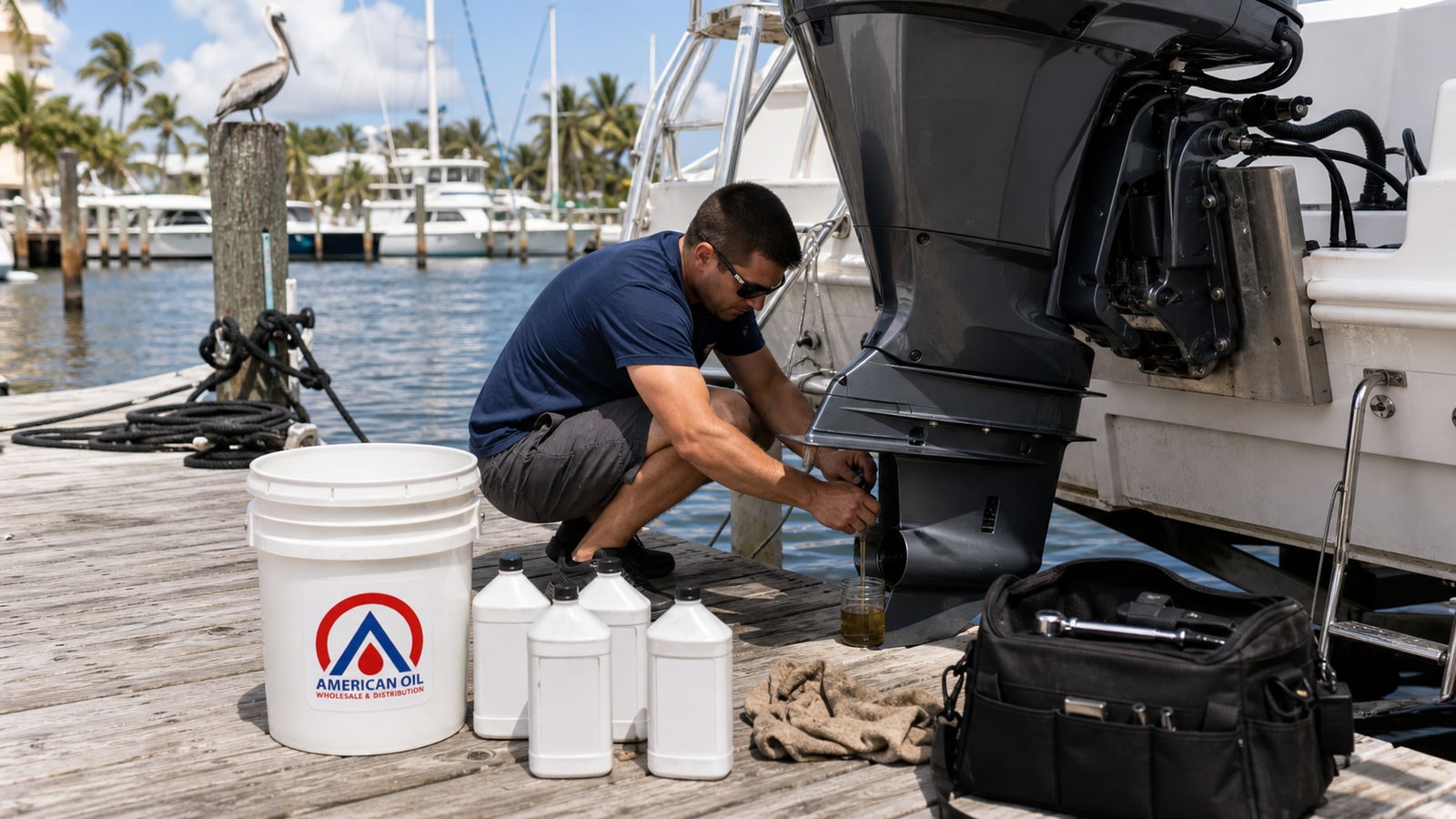
The lower unit (gear case) on an outboard or the gear case on a sterndrive holds the gears that translate engine torque to the propeller shaft. This housing sits at or below the waterline and is subject to water intrusion through the prop shaft seal. It requires a marine-specific gear lubricant, not automotive differential or gear oil.
- Why automotive gear oil is the wrong product here. Standard automotive gear oil is formulated for a sealed, dry gear housing that sees no water intrusion under normal service. A marine gear case regularly sees water mixing into the lubricant through the prop shaft seal. The lubricant must handle water in suspension without foaming, losing film strength, or corroding the bronze and aluminum components common in marine drive units. Marine gear lubricants use additive packages designed for this environment.
- Reading the label. Marine gear case lubricants are sold by viscosity, most commonly in the SAE 80W-90 range, and are labeled specifically for outboard lower unit or sterndrive service. Each major engine maker publishes an approved lubricant list. Mercury, Yamaha, Honda, Suzuki, and Volvo Penta each specify what is approved for their drive units; use the engine maker's approved product list for the specific model you are servicing.
- What to stock. Marine gear case lubricant in quart and gallon containers covers most outboard and sterndrive service needs. Higher-volume sterndrive shops can look at drum quantities for the grade they service most.
Marine grease
Marine greasing applications include propeller shafts, gimbal bearings, steering cables, trailer wheel bearings, and other exposed metal-to-metal fittings in a saltwater or splash-zone environment. Standard automotive chassis grease is not optimized for this.
- Thickener and grade for the marine environment. Marine grease is typically NLGI 2 consistency. Calcium sulfonate complex thickeners offer superior water wash-out resistance and inherent rust protection compared to standard lithium or lithium complex grease, which makes them well-suited for South Florida's coastal and saltwater marine environment. If you already carry a calcium sulfonate complex NLGI 2 grease for coastal automotive customers, that formulation carries into marine applications well.
- What to stock. Marine-grade NLGI 2 grease in cartridges for grease guns is the standard format for a service shop or marina. Shops doing high-volume prop shaft and bearing service can look at pails. American Oil can quote either format on your account.
Packaging for a marine service operation
Marine lubricants follow the same volume-packaging logic as automotive: the cost per quart drops as the package gets bigger, and the right package is the one you can turn.
- Cases are the right starting point for a shop that sees marine work alongside automotive. TC-W3 and FC-W in cases let you stock multiple grades without overcommitting volume on any single line. Marine gear lubricant and grease in cases or individual containers fits a multi-service shop.
- Pails make sense when you know you move enough of one grade consistently. A marina with a high two-stroke outboard count may reach pail volume on TC-W3 faster than you expect. A busy sterndrive shop can reach pail volume on gear case lubricant.
- Drums and totes are the right choice for a high-volume dedicated marine operation moving a single grade at consistent weekly volume. Drums bring per-quart cost down significantly over cases; a tote is the floor when the throughput is there. Both require a pump and storage space.
Open your wholesale account at aoilw.com, tell us your marine grades and your monthly service volume, and we will quote the tier that drops your cost per quart the most.
The South Florida and Caribbean angle
South Florida runs year-round boating. Miami and Fort Lauderdale together hold one of the highest concentrations of registered recreational vessels and professional marine service operations in the country. The season does not end in the fall, which means marine lubricant demand here is not seasonal, and a shop or marina needs a wholesale supply that reflects consistent throughput year-round.
The Caribbean export angle extends this further. Outboard and inboard marine engine service is a daily-use business throughout the Bahamas, Jamaica, Puerto Rico, the Dominican Republic, and across the Eastern and Southern Caribbean. TC-W3, FC-W, and marine gear case lubricants are the same product standards used across those markets. American Oil exports to the Caribbean and Latin America by freight forwarding and container loading, so a marine distributor or marina operator in the islands can open an account with us and receive the same product lines our South Florida customers do.
Stock the right marine lubricant wholesale with American Oil
Match the NMMA mark to the engine: TC-W3 for two-stroke outboards, FC-W or FC-W Catalyst Compatible for four-stroke marine engines, a marine-specific gear lubricant for the lower unit or sterndrive gear case, and a water-resistant marine grease for prop shafts and exposed fittings. Open your wholesale account at aoilw.com, or call American Oil Wholesale and Distribution, to get a quote by package tier (case, pail, drum, or tote) and set up delivery from West Palm Beach to Homestead, with Caribbean and Latin America export available. Tell us your marine grades and your service volume and we will quote the tier that drops your cost per quart the most.
Sources
- National Marine Manufacturers Association (NMMA), TC-W3 two-stroke outboard engine oil certification and FC-W four-cycle marine engine oil certification. https://www.nmma.org
- SAE International, SAE J300 engine oil viscosity classification. https://www.sae.org