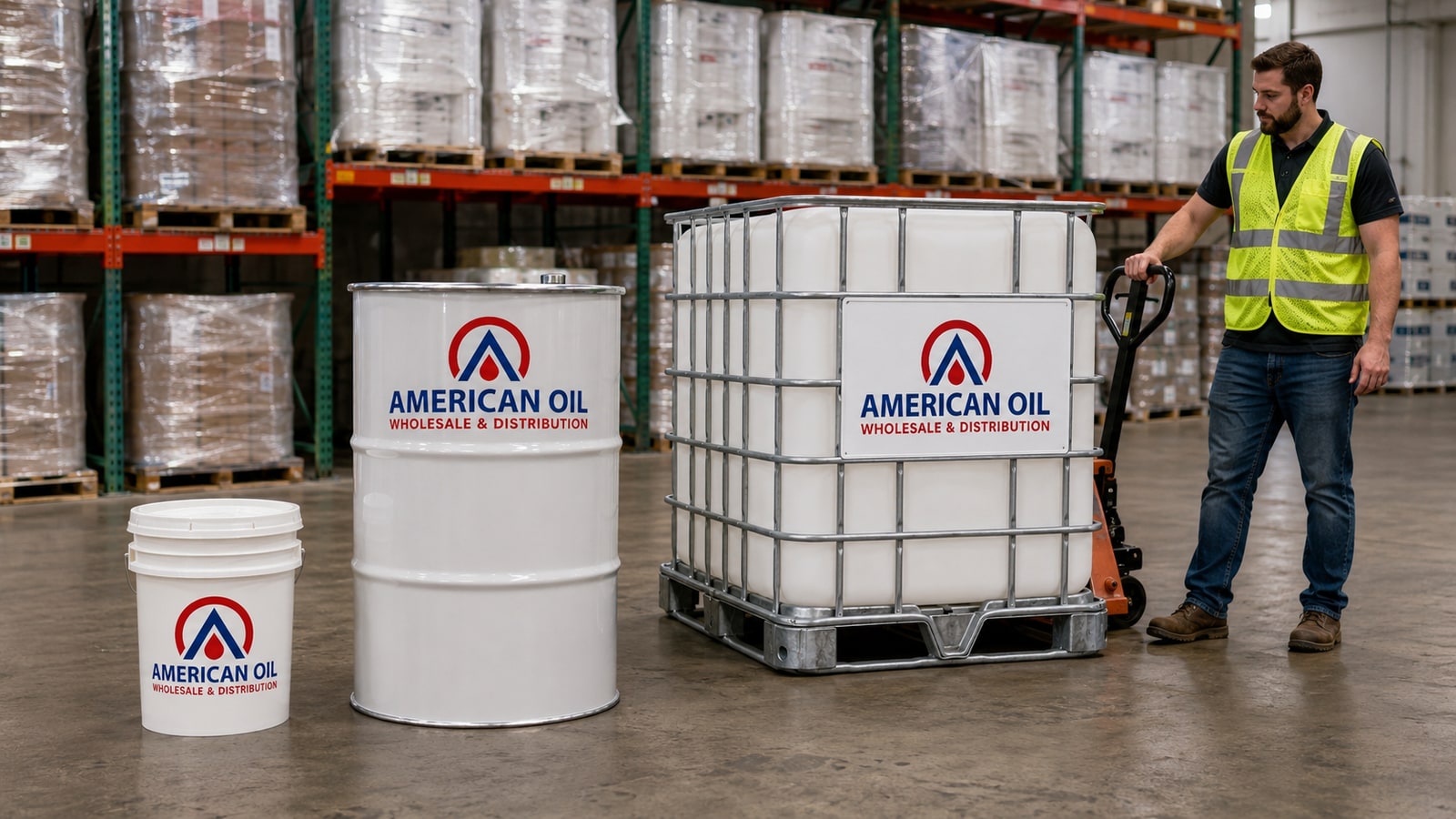
Buy each lubricant in the largest container you can finish before it ages, because your landed cost per gallon falls as the package gets bigger: a 5-gallon pail is the most expensive way to buy oil per gallon, a 55-gallon drum is cheaper, and a 275 or 330-gallon tote is cheaper still. The right container is set by how fast you turn the grade, not by the price tag on a single unit. A grade you move every week belongs in a drum or a tote; a grade you touch once a month belongs in a pail. We stock American Oil in all three formats so you can size each product to its own velocity when you open a wholesale account at aoilw.com.
The container math, in whole units
Start with the volumes, because the ratios do all the work and none of them require a price.
- A 55-gallon drum holds the same oil as 11 pails (55 divided by 5).
- A 275-gallon tote holds the same oil as 55 pails, or 5 drums.
- A 330-gallon tote holds the same oil as 66 pails, or 6 drums.
A tote is an intermediate bulk container, or IBC, in the standard 275 and 330-gallon sizes. A drum is the 55-gallon steel or poly unit. A pail is the 5-gallon unit. Those numbers are fixed by the containers, so every comparison below is arithmetic on top of them.
Why bigger containers cost less per gallon
The unit cost falls with size for reasons that have nothing to do with the oil itself. The oil is identical; the package is what changes.
- Packaging spreads over more gallons. A pail, a drum, and a tote each carry a one-time container and closure cost. Buy a tote instead of the 55 pails it replaces and that fixed packaging cost is divided across 275 gallons instead of being charged 55 separate times. The more gallons under one lid, the lower the packaging cost per gallon.
- Handling collapses. Receiving one tote is a single forklift pick. Receiving the same 275 gallons in pails is 55 separate lifts across multiple pallets. One tote replaces 5 drums on the same logic. Fewer picks means less labor per gallon on the dock and at the point of use.
- Freight rides on the same volume with less packaging. Freight is paid on weight and pallet space. Loose pails waste cube and stack poorly; drums and totes palletize tight. Consolidating a grade into a tote moves the same gallons with less wasted space, so the inbound freight per gallon drops.
- Fewer empties to manage. Every pail and drum is a container you store, track, and dispose of. One 275-gallon tote retires 55 pail disposals or 5 drum disposals. The disposal and handling cost that would have spread across 55 empties now spreads across one, so disposal per gallon falls the same way packaging does.
None of that needs a price list to understand. Packaging, handling, freight, and disposal are fixed costs per container, so dividing them across more gallons is the whole mechanism that lowers your cost per gallon. That is the entire case for buying big.
Match the container to turnover, not to the sticker
The common mistake is choosing by the price of one unit instead of the cost of a gallon over the life of the package. A drum looks like a bigger commitment than a pail until you remember it is 11 pails of the same oil bought at once, then divide by how fast you use it.
Use this logic:
- Estimate weekly usage of the grade. How many gallons of this exact product do you actually move in a typical week?
- Pick the format you will finish in a reasonable window. A working rule many shops use is to size the container so you draw it down within a few months, before the oil has sat long enough to be a concern and before your cash is tied up too long.
- Let each grade pick its own format. Your fastest mover and your slowest mover should not be in the same size. A grade you go through weekly earns a tote; a rarely touched specialty grade stays a pail.
The payoff is a shelf where the cost per gallon is as low as your turnover allows on every line, not just the popular ones.
The three formats, and who each one is for
5-gallon pail
The pail is the right call for low-volume grades, specialty fluids, and any product you cannot finish fast in a bigger package. It is the most expensive per gallon, and that is the correct trade when the alternative is a half-used drum aging on the floor. Pails move by hand and need no pump.
55-gallon drum
The drum is the workhorse middle. For a grade you go through steadily but not in tote volume, buying 11 pails worth at once drops your cost per gallon well below the pail while staying manageable with a basic drum pump and a dolly. Most shops have a handful of grades that live best in drums: common engine oils, the everyday hydraulic grade, the high-runner gear oil.
Tote (275 or 330 gallon)
The tote is the lowest cost per gallon and the right home for your highest-volume lines. One tote is a single forklift pick and one set of paperwork in place of 55 pails or 5 drums, so it cuts handling and empties the hardest. It needs floor space and a way to dispense, but for a grade that truly moves, it is the cheapest gallon on the floor.
A South Florida and export note on cube
Where this really bites is the export floor. We load Caribbean and Latin America orders out of our Hialeah warehouse, and ocean freight is sold by container slot and weight, not by the gallon. Pack a 20 or 40-foot export container with loose pails and you pay for the air between them and for the labor to palletize 55 small units per tote-equivalent. Pack the same gallons as drums and totes and the cube fills clean, the pick count drops, and the per-gallon ocean freight and handling to San Juan, Santo Domingo, or Kingston comes down with it. The same logic applies to warehouse rent in the Miami market: a tote stores far more gallons per square foot than the pails it replaces. For volume buyers and exporters, the big formats are cheaper to buy, cheaper to ship, and cheaper to hold.
How turnover changes the answer over time
Container choice is not a one-time decision. As a grade's demand shifts, the right format moves up the chain. A grade that started as a pail becomes a drum when it turns every week, and becomes a tote when you are opening drums faster than you can pump them. Review your fastest movers every season and push each one up to the next format as soon as its turnover supports it. That is where the per-gallon savings compound, without changing a thing about the oil.
Stock heavy where you move heavy
For a shop or distributor buying in volume, the drum and the tote are where the savings live. We carry the full American Oil line in pail, drum, and tote, and our white-label bulk units are built for exactly this kind of volume buyer; Thunder Oil covers the cases and quarts for the counter. If a grade is moving fast enough to justify a drum or a tote, that is the format that puts the most margin back in your pocket, and it is the format we want to quote you. A wholesale account at aoilw.com is how we size every line on your shelf to its turnover.
Open a wholesale account
Tell us your volume by grade and we will build a stocking plan that puts your fast movers in drums and totes and keeps your slow grades in pails, so every line on your shelf sits at the lowest cost per gallon your turnover supports. Open a wholesale account at aoilw.com.
Sources
- ISO 1496 and UN/DOT container standards for IBC totes (275 and 330 gallon), 55-gallon steel and poly drums, and 5-gallon pails.
- API and SAE guidance on lubricant storage life and shelf-life management for opened and unopened containers.
- American Oil Wholesale and Distribution product line documentation (pail, drum, and tote formats for the white-label bulk line).