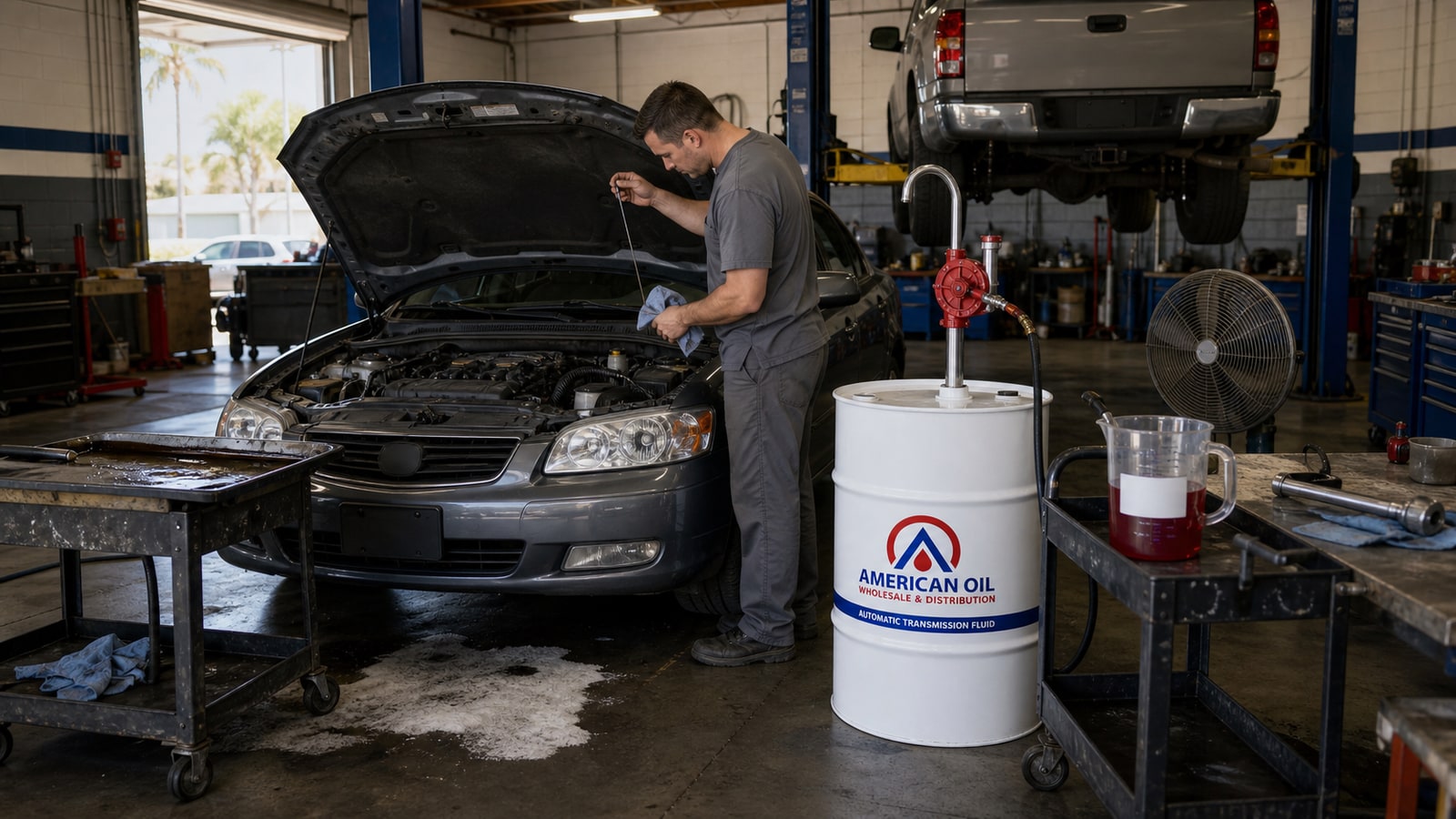
The right automatic transmission service uses the OEM-required ATF category, follows the OEM-specified interval, and chooses between a drain-and-fill and a machine-assisted flush based on the fluid's actual condition. Get those three decisions right before any fluid goes in. American Oil Wholesale and Distribution (aoilw.com), a Hialeah-based full-line distributor, carries ATF in 55-gallon drums in the Dexron VI, Mercon V, ATF+4, and multi-vehicle spec families, on the same account as your motor oil, DEF, and gear oil.
If you run a South Florida shop with a transmission service bay, the interval question and the fluid-spec question arrive together. The wrong answer on either one means a comeback or a warranty problem. This guide covers when to service an automatic transmission, what the drain-and-fill versus flush decision actually turns on, and how to match the OEM's required ATF category so you stock the right fluid and turn it at the volume that drops your cost per quart.
Why ATF degrades and why South Florida matters
Automatic transmission fluid handles hydraulic power, friction control, and lubrication at the same time. The additives behind all three deplete over time, and heat is the primary driver. Chrysler's ATF+4 specification (Stellantis Material Standard MS-9602) defines the friction modifier chemistry and oxidation stability requirements for Chrysler, Dodge, and Jeep automatic transmissions from 1998 onward, and it sets those requirements against the operating temperature range the transmission is engineered for. When the operating temperature rises above that baseline, additive depletion accelerates.
South Florida's ambient conditions matter here. A transmission running stop-and-go in Hialeah or Miami in July runs at a higher sustained operating temperature than the same transmission in a northern climate. That higher baseline does not necessarily cut the mileage interval in half, but it does mean the fluid reaches the same oxidation state earlier in the interval. For high-cycle vehicles, including local delivery trucks, taxis, and shop-use vans, the practical service life tracks the shorter end of the OEM's published range.
When to service: reading the OEM interval correctly
Most OEM ATF intervals fall in a range, typically 30,000 to 60,000 miles for normal service, with a shorter severe-service interval. Most OEMs define severe service to include frequent short trips, sustained high-ambient-temperature operation, stop-and-go traffic, and towing or hauling loads. A vehicle spending its work week in South Florida urban traffic, running school routes, or making delivery stops qualifies for the severe-service interval under most OEM definitions.
Some OEMs specify "lifetime" ATF, meaning no scheduled drain in the vehicle's designed service life. That designation reflects the fluid's formulation under controlled conditions; it does not mean the fluid cannot degrade under hard or hot use. When a customer's transmission shows a shudder, delayed engagement, or erratic shifts and the ATF has not been serviced, a drain-and-fill is the practical first step regardless of what the OEM's sticker says. Inspect, service, and document what you find.
Drain-and-fill versus machine flush: the real decision factors
A transmission pan drain removes the ATF in the pan. The torque converter retains fluid because it does not drain under gravity, so a single pan drain-and-fill replaces roughly one-third to one-half of the transmission's total ATF volume. The rest stays in the converter and cooler lines.
A machine-assisted exchange, using a flush tool adapted to the cooler line, circulates new ATF through the system while the old fluid is expelled, cycling until the outgoing fluid approaches the color and clarity of the incoming fluid. A full exchange can replace close to the total ATF volume.
Three factors govern the decision:
- Fluid condition. Clear amber or red ATF with no burnt smell, sludge, or metal fines is a candidate for a drain-and-fill: you are refreshing additive chemistry, not flushing a contamination problem. Dark, oxidized fluid with a burnt smell calls for more fluid replacement. Contaminated fluid with metal fines, water, or coolant intrusion points to a more serious diagnosis before any service decision.
- High-mileage, never-serviced transmissions. Some technicians avoid a full flush on a high-mileage, never-serviced transmission on the reasoning that accumulated deposits may be providing some sealing, and that a full flush can precipitate a failure that was already building. This is a technician judgment call made on inspection. It is not a reason to skip service; it is a reason to inspect before committing to the method.
- Multiple drain-and-fills as a middle path. Doing two or three drain-and-fills in sequence, driving briefly between them, dilutes the old fluid progressively. Two or three staged drain-and-fills can approach the renewal ratio of a single full exchange. This works for shops that do not run a flush machine and want to do more than a single pan drain.
Which ATF: OEM spec governs, not universal
Automatic transmission fluid is not universal. The friction modifier package, viscosity profile, and oxidation inhibitor chemistry are matched to the specific clutch pack, band, and valve body of each transmission design. Putting the wrong ATF in a transmission can cause shudder, slip, or shortened clutch life. The OEM categorization system you encounter most often in a South Florida shop:
- GM Dexron VI is the current GM specification, first introduced in 2005, and is backward compatible with older Dexron III and IIIH-specified transmissions (General Motors, Dexron VI fluid specification). Use Dexron VI for any GM automatic unless the OEM specifically prohibits it for that transmission.
- Ford Mercon V covers most Ford automatic transmissions from the late 1990s through the mid-2000s. Mercon V is not forward compatible with newer Ford specifications (Mercon SP, Mercon LV); each is a distinct chemistry that Ford matched to its clutch materials. For older applications that originally specified Mercon, Ford retired original Mercon licensing in 2007 and names Mercon V as the service fluid (Ford TSB 07-1-7).
- Chrysler ATF+4 (Stellantis MS-9602) is required for most Chrysler, Dodge, and Jeep automatic transmissions from 1998 onward. ATF+4 is a friction-modified formulation calibrated to Chrysler's clutch pack materials; a generic multi-vehicle ATF is not a substitute, even if it meets a broad viscosity range.
- Allison TES 668 is the current Allison Transmission specification for Allison automatics, common in commercial vehicles, vocational trucks, and transit applications; it superseded the legacy TES 295 specification in 2020 and is backward compatible with TES 295 applications. Allison publishes approved product lists for both specifications, naming the specific oils that have passed the full Allison transmission test program (Allison Transmission, TES 668 and TES 295 specifications). This is a specialty category; use only Allison-approved products.
- Multi-vehicle ATF covers a broad range of older or cross-brand specifications. Verify that the multi-vehicle fluid you are using explicitly covers the required OEM category before using it; "multi-vehicle" is a coverage claim, not a universal approval.
We carry ATF in 55-gallon drums in Dexron VI, Mercon V, ATF+4, and multi-vehicle spec families at account pricing. One account with American Oil at aoilw.com covers your ATF alongside motor oil, DEF, gear oil, and coolant, all on one delivery route from West Palm Beach to Homestead, with Caribbean and Latin America export available.
Stocking ATF for a transmission service bay
The volume math favors drums for most ATF in a transmission bay. A typical passenger car or light truck automatic transmission holds 8 to 14 quarts of ATF total. A 55-gallon drum holds 220 quarts. At a transmission-pan service volume of 4 to 7 quarts per service (the pan portion), a single drum supports 30 to 55 drain-and-fills on that spec. When you turn your highest-volume ATF spec through a drum, you spread one wholesale rate across those 220 quarts instead of carrying a per-bottle markup on every quart. Your cost per quart drops, your restocking trips drop, and your bay does not wait on a case order.
Stock your highest-volume specs (typically Dexron VI and Mercon V in a South Florida mixed-fleet shop) in drums. Keep case inventory for ATF+4 and any import or luxury OEM ATF your shop sees less frequently. Tell us your grades and your monthly volume and we will quote the tier that drops your cost per quart the most.
Service the transmission right, and buy the fluid right
Get the spec right first: match the OEM's required ATF category, choose your service method on the actual condition of the fluid, and then buy at the volume that drops your cost per quart. Open your wholesale account at aoilw.com, or call American Oil Wholesale and Distribution, to get a quote on drum pricing for your highest-volume ATF specs, bundle it with your motor oil, DEF, and coolant on one account, and set up delivery from West Palm Beach to Homestead, with Caribbean and Latin America export available.
Sources
- General Motors, Dexron VI Automatic Transmission Fluid specification. https://www.gm.com
- Stellantis, Material Standard MS-9602 (ATF+4 Automatic Transmission Fluid specification). https://www.stellantis.com
- Allison Transmission, TES 668 and TES 295 Transmission Fluid Specifications and approved product lists. https://www.allisontransmission.com
- Ford Motor Company, Mercon V Automatic Transmission Fluid specification and TSB 07-1-7. https://www.ford.com
- SAE International, SAE J311 (Fluid for Passenger Car Type Automatic Transmissions). https://www.sae.org