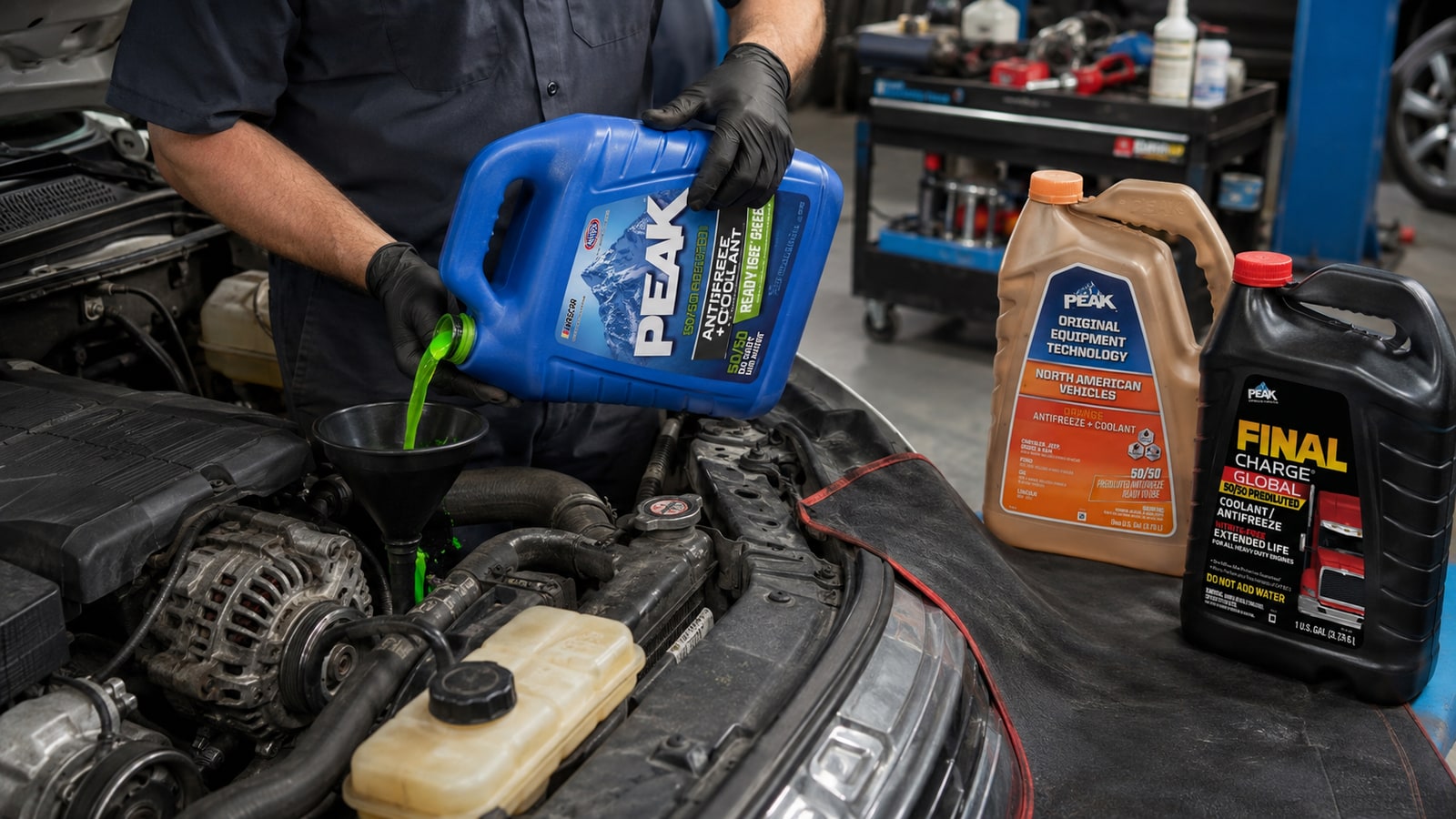
The color in your customer's coolant reservoir is not a quality rating. It is a chemistry signal. Green means silicate-based IAT inhibitors. Orange means carboxylate OAT inhibitors, the family that includes Dex-Cool. Pink, blue, yellow, red, and purple or violet each point to HOAT or Asian-OEM hybrid formulations that combine silicate and carboxylate chemistry in different proportions. Matching the wrong color is a refill mistake; mixing incompatible families without flushing is a cooling system failure. At aoilw.com, we carry the full Thunder antifreeze and coolant program across all of these color families in cases, drums, and totes so your South Florida shop can cover every make that rolls through the bay.
The Three Inhibitor Families
IAT: Green (ASTM D3306)
IAT stands for Inorganic Additive Technology. The inhibitors are silicates and phosphates, which form a passive protective layer across metal surfaces on contact. ASTM D3306, the governing specification for glycol-based engine coolant in passenger-car and light-duty service, sets freeze protection to -34 degrees F (-37 degrees C) at a standard 50/50 mix with deionized water (ASTM D3306). The silicate layer depletes through normal service, which is why IAT coolants require more frequent changes than OAT or HOAT formulations. IAT is still the correct choice for older domestic vehicles and engines designed around silicate protection. Our stocking SKUs for this family: Thunder Green 50/50 Antifreeze & Coolant and Thunder Green Concentrate Antifreeze & Coolant.
OAT: Orange (ASTM D6210, Dex-Cool)
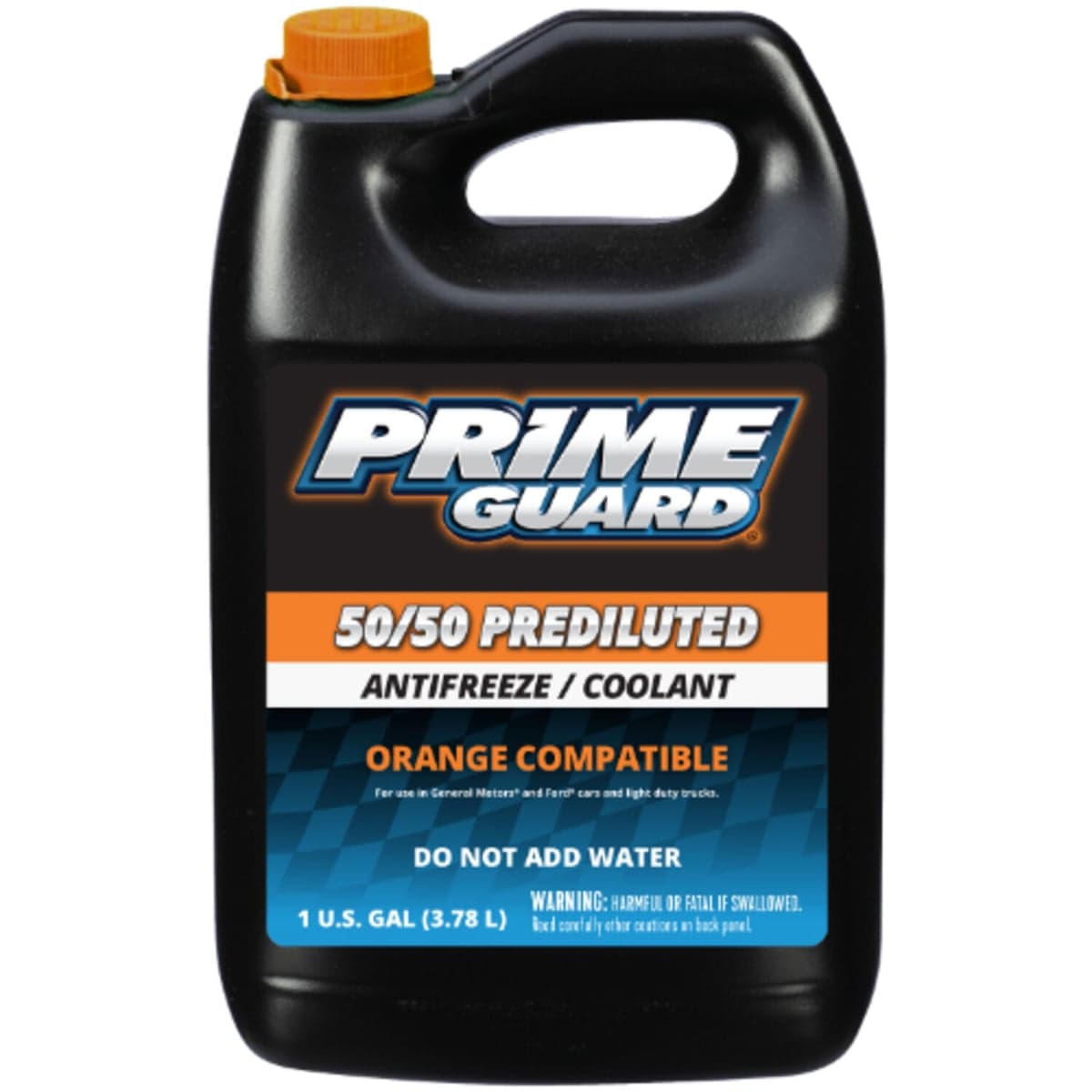
OAT, Organic Acid Technology, replaces silicates with carboxylate inhibitors that adsorb selectively onto metal surfaces only where corrosion is forming, rather than blanketing the entire system. This targeted mechanism is why OAT carries longer service intervals. ASTM D6210 governs fully-formulated OAT coolants for heavy-duty diesel and natural gas engines; no SCA pre-charge is required when coolant is maintained at concentration. For passenger vehicles, GM's Dex-Cool is the dominant OAT specification, required across Chevrolet, Buick, GMC, and Cadillac beginning with model year 1996. Subaru and several Saab models also called for OAT chemistry. Our stocking SKUs: Thunder Dex-Cool 50/50 Antifreeze & Coolant and Thunder Dex-Cool Concentrate Antifreeze & Coolant.
HOAT and Asian Formulations: Yellow, Pink, Blue, Red, Purple/Violet
HOAT, Hybrid OAT, combines low-dose silicates with carboxylate OAT inhibitors to deliver rapid protection onset with extended service life. European and Asian OEMs each chose a dye that works with their resin systems, so no single color maps cleanly to one manufacturer across all model years:
- Yellow: universal HOAT formulations and certain European OEM applications; our stocking SKU is Thunder Universal Yellow 50/50 Antifreeze & Coolant
- Pink: Toyota and Lexus Super Long Life Coolant (SLLC)
- Blue: BMW and Mini (certain model years), Hyundai and Kia (certain model years)
- Red: Toyota and Lexus older LLC generations and various Asian OEM specs
- Purple/violet: Volkswagen Group G12++ and G13 (Global HOAT and silicate-free HOAT)
ASTM D4985 covers low-silicate ethylene glycol coolants for heavy-duty diesel engines requiring a supplemental coolant additive (SCA) pre-charge. For the Japanese and Korean makes that make up a large share of South Florida's vehicle population, check the reservoir cap or the owner's manual for the OEM designation before choosing a SKU. Our cross-reference chart maps every color family to its controlling specification and common OEM designations. Stocking SKUs for Asian-spec shops: Thunder Asian Blue 50/50, Thunder Asian Green 50/50, Thunder Asian Pink 50/50, Thunder Asian Red 50/50, and Thunder Universal Asian 50/50 Antifreeze & Coolant, plus concentrate versions of each.
Why Mixing Families Fails
When incompatible inhibitor families combine, the silicate and carboxylate chemistries compete rather than cooperate. The pH of the mixture can drop, corrosion protection in both packages weakens, and aluminum components face accelerated pitting. A system that received one top-off of the wrong color needs a full flush before the correct coolant can do its job. This is not a brand preference issue; it is inhibitor chemistry. Shops that service diverse makes will encounter this regularly, which is why stocking by inhibitor family is the baseline for any South Florida auto shop running a mix of domestic, Japanese, Korean, and European vehicles.
Stocking for a Mixed-Make Market
A South Florida service bay handles more vehicle nationalities than almost any other region in the country: domestic trucks (Ford, GM, Ram), Japanese imports (Honda, Toyota, Nissan, Subaru), Korean makes (Hyundai, Kia), European vehicles (VW, BMW, Mercedes-Benz), and Caribbean-registered vehicles with service histories that may not follow OEM intervals. Stocking by inhibitor family is the only practical approach. Mixed-equipment fleets face the same challenge across preventive maintenance cycles.
Four core stocking families cover most of what rolls into a South Florida bay: IAT Green for domestic and older engines (Thunder Green 50/50); OAT Orange for GM and other OAT-spec vehicles (Thunder Dex-Cool 50/50); Universal Asian for Japanese and Korean OEM specs (Thunder Universal Asian 50/50); and Universal Yellow for yellow-dyed HOAT applications and certain European specifications (Thunder Universal Yellow 50/50). For VW, BMW, and other European makes with specific color designations, verify the OEM designation on the reservoir cap and check our cross-reference chart before selecting a SKU. Each family is available in 6/1-gallon cases for shop-bay use, 55-gallon drums for steady-volume shops, and 275-gallon totes for high-volume operations. Concentrate versions let shops control dilution ratios and mix with deionized water on the bench.
One Wholesale Account Covers All Families
With one trade account, you can order every Thunder coolant family directly from our Hialeah warehouse without managing multiple suppliers. We deliver next-day across Miami-Dade, Broward, and Palm Beach counties, or you can pick up at the warehouse. To open an account or request a quote on any coolant SKU, visit aoilw.com/quote or reach our team by phone or WhatsApp.