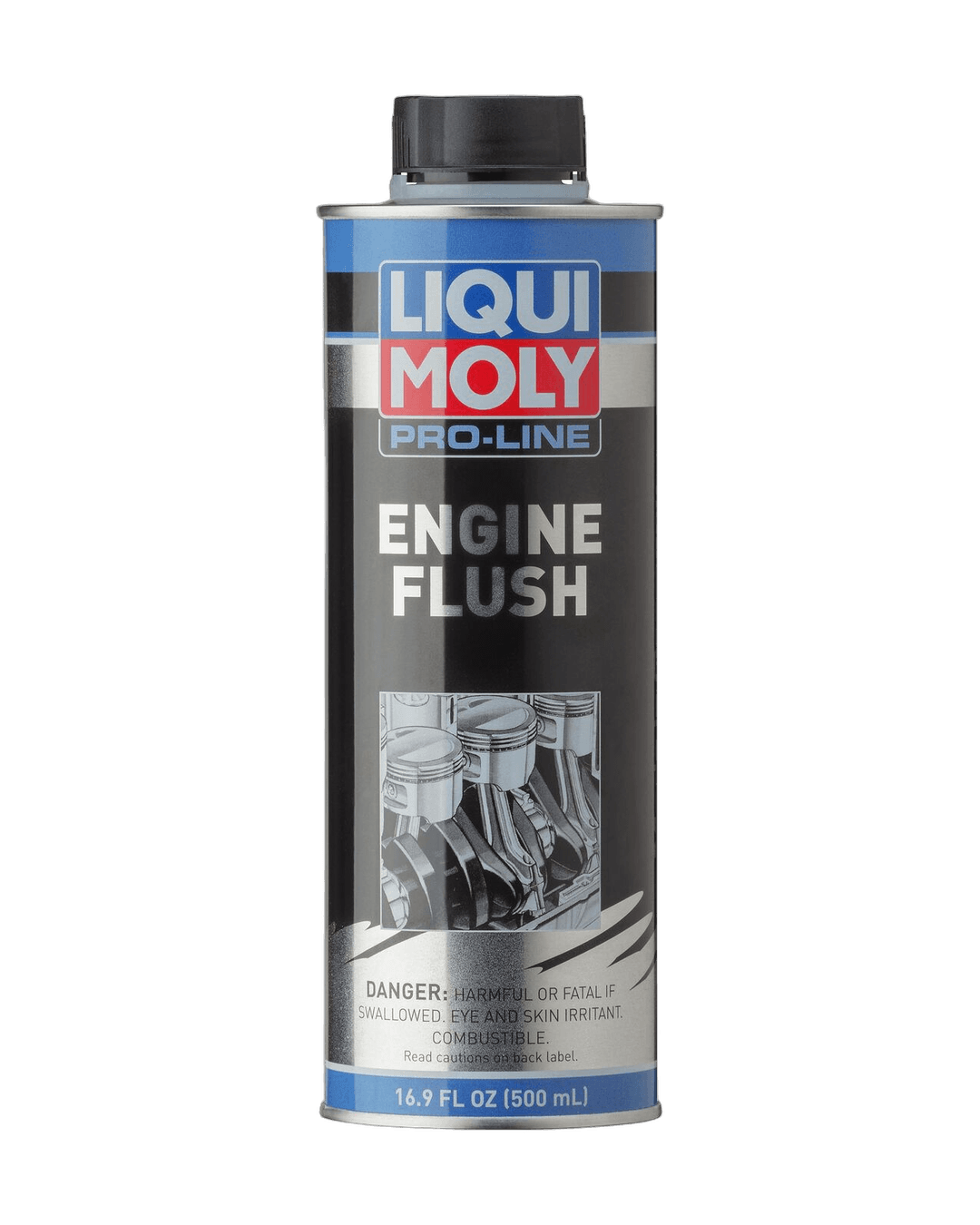
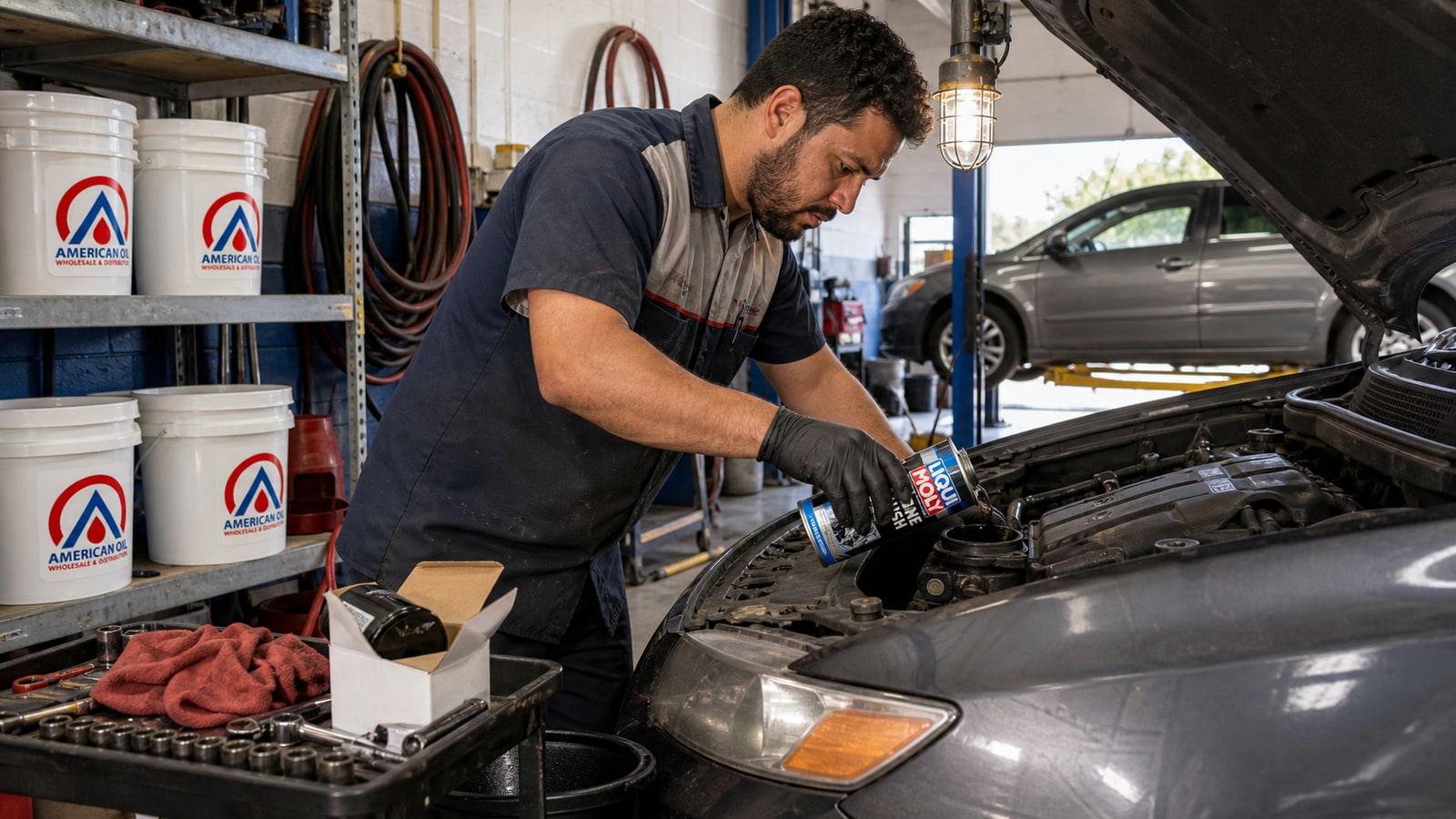
Engine flush is a crankcase cleaner added to warm old oil before draining; it circulates at idle, loosens sludge and varnish deposits, and drains out with the old oil. It is not a routine step on a well-maintained engine, but it has specific, legitimate uses: servicing a neglected engine with visible sludge, clearing a vehicle with an unknown service history, or making a conventional-to-synthetic switch on a high-mileage engine where dissolved varnish can open slow leaks. We carry Liqui Moly Engine Flush by the case at aoilw.com for shops that want to keep a treatment on hand for the right situation.
If you run an auto shop in South Florida, the question is not whether engine flush works but when it earns its spot in the service ticket. Using it on every drain is not better for the engine and adds cost for the customer where no problem exists. Recognizing the four situations where it actually prevents a worse repair is where the value is.
What engine flush is and how it works
Engine flush is a blend of solvents and detergents poured into the existing crankcase oil, not the fuel tank, with the engine warm. Per the Liqui Moly Engine Flush product instructions, you add the 500 ml can, run the engine at idle for 10 minutes, then drain the oil and replace the filter. The flushed oil carries out loosened deposits; the fresh oil goes in clean.
The chemistry targets two failure-mode residues. Sludge is oxidized oil polymerized into a semi-solid or gel-like deposit that restricts oil passages and starves bearings. Varnish is a dry, lacquer-like film that builds on piston rings, valve lifters, and spool-valve surfaces, restricting movement and precision clearances. Both form when oil degrades from heat, moisture, and combustion blowby products, and both stay in the engine when you drain without flush unless they happen to be in suspension.
A key principle from SAE International and STLE (Society of Tribologists and Lubrication Engineers) lubrication engineering publications: oil oxidation rate approximately doubles with each 10 degrees C rise in bulk oil temperature, following Arrhenius-based thermal degradation models (SAE International tribology educational materials; STLE lubrication fundamentals training). South Florida's annual average temperature runs roughly 10 to 15 degrees C above most northern U.S. markets (NOAA/NWS public climate data; Miami annual average approximately 25 degrees C versus Chicago approximately 10 degrees C, Cleveland approximately 10 degrees C, and New York approximately 13 degrees C), which means engines here operate under a meaningfully accelerated oxidation load between drains. A shop that sees customers push drain intervals in South Florida heat is a shop that will encounter sludge more often than a shop in Chicago or Cleveland.
When to use engine flush: four situations
1. Unknown service history. A vehicle acquired from auction or a private sale with no maintenance records may have missed several drains. Flushing before the first drain removes whatever deposited residue the unknown-history oil left behind, so the fresh oil starts clean rather than picking up residue from a questionable past.
2. Conventional-to-full-synthetic switch on a high-mileage engine. Full synthetic motor oils are formulated with more aggressive detergent and dispersant additive packages than many conventional oils, which is why synthetic generally keeps engines cleaner. On a high-mileage engine, that detergency works against you in one specific scenario: if varnish deposits around worn seals were partially bridging a slow leak, the synthetic's detergent package dissolves those deposits and the leak opens up. Flushing before the switch removes the loose deposits so the fresh synthetic does not expose a seal problem mid-job or carry dissolved material through the engine on the first drain.
3. Visible sludge at the fill cap or dipstick. If a tech pulls the fill cap and finds a dark, gel-like or tarry deposit, the engine has accumulated sludge. A flush-and-drain is the minimum first step; a second treatment may be needed if the buildup is moderate. This does not replace a valve service or oil-pan cleaning for severe sludge that has blocked galleries, but it handles light-to-moderate buildup that a standard drain would leave behind.
4. Fleet vehicles with high idle time or extended drain intervals. Refrigerated delivery trucks, service vehicles, and any fleet unit that idles for long periods sees lower crankcase temperatures during idle than under road load. Lower temperatures mean more moisture accumulation in the crankcase and less thorough combustion product burnoff. Extended intervals on these vehicles accelerate sludge accumulation relative to a highway-driven unit on the same schedule. A periodic flush on the highest-idle-time units is a cost-effective way to stay ahead of the problem before it requires a more invasive fix.
When to skip engine flush
A well-maintained engine on a consistent drain schedule with a quality API SP-certified oil does not need flush. The detergent and dispersant additive packages in API SP-category oil are engineered to keep a clean engine clean between intervals; flush is for when that program broke down.
If an engine has severe sludge: oil-passage restriction, blocked pickup screens, or audible oil-pressure symptoms, flush alone will not solve it. Severe sludge requires professional cleaning or disassembly. Flush suspends and drains light-to-moderate deposits; it does not clear blocked oil galleries.
Adding flush as a routine upsell on every healthy engine is not better maintenance. It is also not consistent with how API SP-category oil is designed to perform.
Using Liqui Moly Engine Flush in your shop
Liqui Moly Engine Flush comes in 500 ml cans, 6 cans per case. One can treats one engine. Per the product instructions: with the engine warm to operating temperature, add the full can to the existing crankcase oil, run at idle for 10 minutes, then drain, replace the filter immediately, and fill with fresh oil. Do not drive the vehicle during the flush cycle.
For a shop stocking for the four scenarios above, one case of 6 treatments covers the occasional high-mileage unknown-history trade-in or fleet service call without tying up large inventory. For a busy shop handling 5 to 10 auction-sourced vehicles per week, a standing reorder of one case per week keeps the shelf at a sensible level without guessing.
The South Florida and Caribbean export angle
South Florida's used-car market, centered around Hialeah, Doral, Medley, and the dealer-auction belt in the area, sees a disproportionate share of vehicles with patchy or absent service histories. Many come from Latin American markets or from extended use under South Florida's heat and humidity. Both conditions accelerate oil oxidation even when drains happen on schedule, and vehicles from markets with longer OEM-recommended drain intervals may arrive with multiple drain-intervals' worth of accumulated deposits.
Keeping a case of Liqui Moly Engine Flush on the shelf lets a South Florida shop address those specific situations without guessing. For export accounts shipping to the Caribbean and Latin America: Liqui Moly Engine Flush can be included on the same container load as motor oil, gear oil, DEF, and other fluids, on a single invoice from us.
Open a trade account to stock engine flush alongside your full lubricant lineup
Keep Liqui Moly Engine Flush on hand for the four situations that need it. Open your wholesale account at aoilw.com to order by the case alongside your motor oil, ATF, gear oil, coolant, DEF, and grease on one account and one invoice. Caribbean and Latin America export is available on the same account. Tell our reps your engine flush volume and we will quote you the restocking cadence that keeps the shelf covered without overbuying.