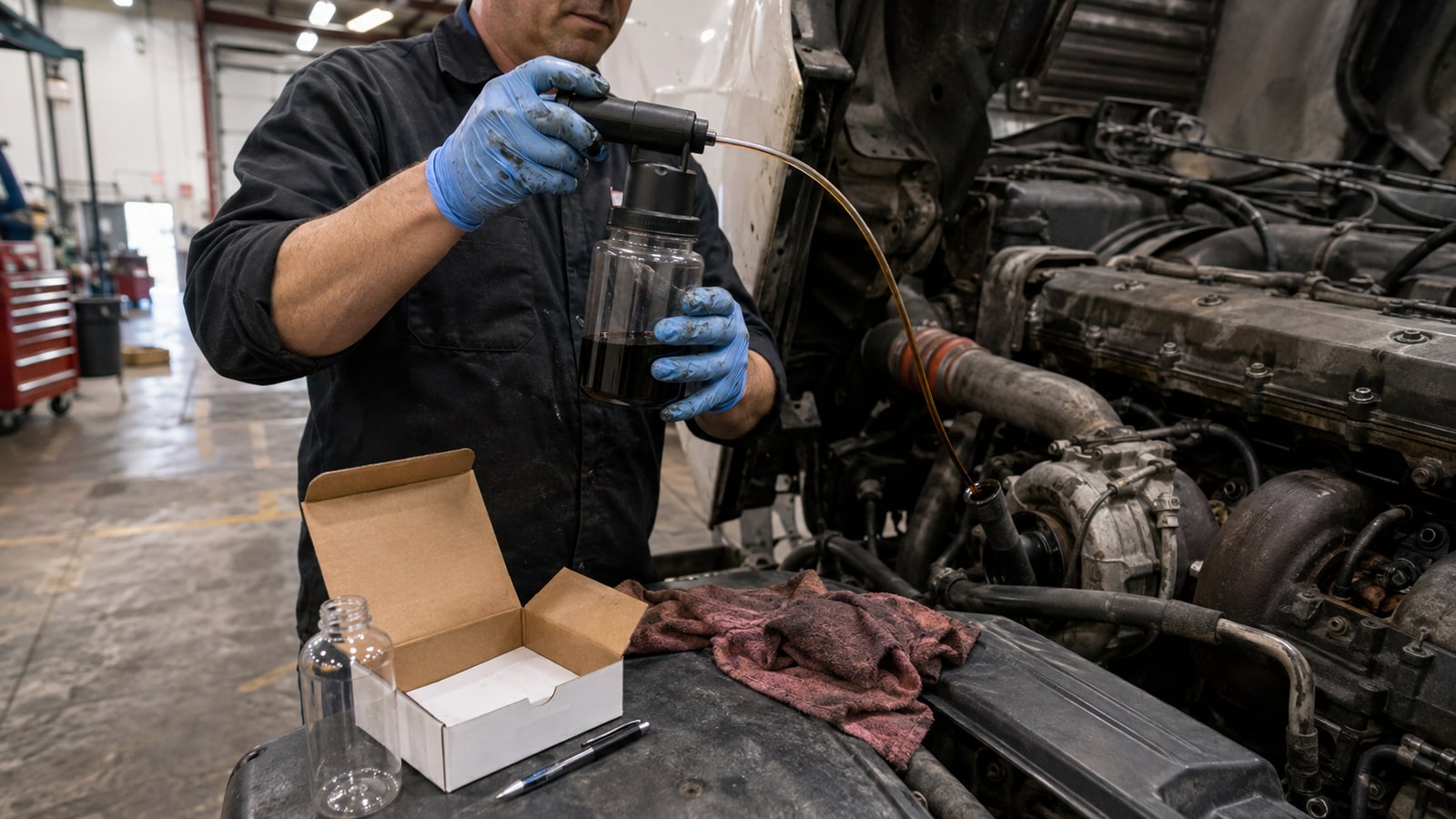
Oil analysis, also called used oil analysis or oil sampling, is how a fleet catches engine wear, contamination, and oil breakdown before they become an unplanned engine repair. You pull a small sample from a running engine, ship it to a laboratory, and get back a report that flags wear metals, viscosity loss, acidity, water content, and fuel dilution. For a South Florida fleet or a high-volume diesel shop, that report is the difference between a planned oil change and a surprise rebuild. We supply the oil, and we want the fleets and shops we serve to get the most from every gallon they run, so this is the plain-language guide to how oil analysis works and what you do with the results. Open your wholesale account at aoilw.com and tell us your grade and monthly volume so we can quote the package tier that makes sense for your operation.
If your fleet is changing oil on a fixed calendar and not on condition data, you are probably changing some engines too early and missing the early warning signs on others. Oil analysis does not replace the OEM drain interval. It gives you data to make an informed, documented decision about when to change and whether something is going wrong before it costs you a truck.
What oil analysis measures
A standard used oil analysis panel from a commercial laboratory covers five categories:
- Wear metals. Spectrometric analysis, typically by ICP (inductively coupled plasma, ASTM D5185) or rotating disc electrode (ASTM D6595), measures the concentration of metals that indicate which engine components are wearing. Iron points to cylinder walls and rings. Copper points to bearings and bushings. Aluminum points to pistons and housing. Chromium points to rings and liners. Lead points to bearings. No engine is wear-free, but a spike in a specific element points to a specific problem.
- Viscosity. The lab measures kinematic viscosity at 100 degrees C (ASTM D445). If viscosity drops significantly below the fresh-oil grade, fuel dilution is the likely cause. If it rises, oxidation or soot thickening is the cause. Either direction matters.
- Acidity and base reserve. Total acid number (TAN, ASTM D664) rises as the oil degrades and its acid-neutralizing additives are consumed. Total base number (TBN, ASTM D4739) measures how much neutralizing capacity the oil has left. For a diesel engine running CK-4 oil, a falling TBN is the clock ticking on the oil's useful life.
- Water and coolant contamination. Water content by Karl Fischer titration (ASTM D6304) catches condensation or a cooling system leak. Glycol is the key marker for a coolant leak into the sump. Any glycol present means immediate attention is needed, because glycol in the crankcase attacks bearings.
- Fuel dilution and soot. Fuel in the sump thins the oil and accelerates wear. Soot, measured by FTIR spectroscopy, is normal in a diesel engine but climbs as combustion efficiency drops. Both are tracked on a trend basis.
Most commercial labs also report silicon (dirt ingestion) and sodium (a secondary coolant leak marker alongside glycol). The report compares each element to a reference limit for that engine type and oil type, and flags anything outside the expected range.
How to take a good sample
A sample that is not collected correctly is not worth analyzing. A contaminated or cold sample produces a report that misleads you. Here is what the labs ask for:
- Sample from a running engine at operating temperature. Cold or recently drained oil misrepresents the in-service condition. Pull the sample when the oil is hot and thoroughly circulated.
- Use the dedicated sample port, or a vacuum pump and sucker gun through the dipstick tube. The sample port gives the cleanest, most consistent draw. If you use the dipstick tube, use a clean vacuum pump and a clean tube, and pull from the middle of the oil column, not the very bottom where settled sediment concentrates.
- Use the sample bottle and shipping kit the lab provides. Contamination from a used or dirty container corrupts the wear-metals reading.
- Label every bottle with engine ID, oil type, oil grade, hours on the oil, hours on the engine, and the date sampled. A report without context is difficult to act on. The lab uses that information to set reference limits and build the trend line.
- Sample consistently. If you are building a trend across multiple intervals, sample at the same engine hours each time, from the same port, with the same method. Consistency is what makes the trend reliable.
How to read the report
A single-sample report tells you about current condition. A trend over three or more intervals tells you whether things are getting better, stable, or getting worse. Here is how to use both:
- Green, yellow, red flags. Most labs use a traffic-light or numeric-flag system. Green means the element is within the reference limit for that engine and oil type. Yellow means elevated and worth watching. Red means act now.
- Look at the trend, not just the flag. An iron reading at 60 percent of the limit but rising fast over three consecutive samples is more concerning than a reading at 90 percent of the limit that has been stable for ten intervals. Rate of change tells you more than a single data point.
- Viscosity deviation is a diagnostic trigger, not just a number. A significant viscosity loss from the fresh-oil grade almost always points to fuel dilution. The lab will flag it, but the repair is finding why fuel is getting into the sump, not just changing the oil.
- Glycol is a stop-now reading. There is no acceptable glycol level in a crankcase. Any glycol means a coolant leak into the oil, and the engine needs attention before the next service interval.
- Act in three tiers. If everything is green, change the oil and return to normal sampling. If anything is yellow, increase sampling frequency and monitor. If anything is red or glycol is detected, change the oil immediately and investigate the flagged element.
The South Florida and export angle
South Florida's year-round heat means engines run at higher operating temperatures for longer stretches than in a northern market. That accelerates oxidation and TBN depletion. Engines that would easily reach a comfortable drain interval in a cooler climate may reach the same level of degradation faster here. That is not a reason to shorten drain intervals without data. It is a reason to run oil analysis so you have the actual data to make the right call for your specific fleet in your climate.
Humidity matters too. Vehicles and equipment that sit between shifts, especially outdoors, condense moisture in the crankcase. On a humid South Florida morning, crankcase condensation is a real source of water contamination, and it shows up in a well-run analysis panel. Engines with lots of short-trip operation or extended idle time are the most exposed to moisture buildup.
For Caribbean and Latin American fleet accounts, oil analysis data has an additional value: it documents the drain interval justification for warranty and maintenance records, and helps fleet managers in markets with tighter maintenance infrastructure extend drain intervals confidently, knowing the data supports the decision.
How analysis data feeds your wholesale purchasing
Once you have a few sampling intervals behind you, the data tells you the grade and volume your fleet needs with more precision than a general stocking guide does. An engine running CK-4 15W-40 that consistently shows low TBN by a certain mileage point tells you that grade's practical drain interval in your fleet. An engine where viscosity is stable and TBN holds well past the OEM recommendation tells you something different. That kind of data lets you order by the drum or tote with confidence, because you know the consumption rate, the drain interval, and the grade, instead of guessing on all three.
We supply CK-4, FA-4, and gasoline-engine oil by the gallon, pail, drum (55-gallon), and tote (IBC, about 275 to 330 gallons). The cost per quart drops as the package gets bigger, because a drum or tote spreads one wholesale rate across hundreds of quarts instead of a per-bottle markup. When your analysis data tells you that your fleet runs through a specific grade at a known rate, you can buy in the format that matches that volume and stop paying case prices on your highest-consumption grade. Open your wholesale account at aoilw.com and tell us your grade and your monthly volume, and we will quote the package tier that drops your cost per quart the most.
Stock the right oil, change it at the right time, with American Oil
Oil analysis does not replace the OEM drain interval or the spec on the bottle. It gives you real data on what is happening inside your engines so you can make a documented, confident decision about when to change and whether something needs attention before the next scheduled service. Once your analysis program tells you the grade you need and how fast you consume it, open your wholesale account at aoilw.com, or call American Oil Wholesale and Distribution, to get a quote by package tier, and set up delivery from West Palm Beach to Homestead, with Caribbean and Latin America export available. Tell us your grade and your monthly volume and we will quote the package that drops your cost per quart the most.
Sources
- ASTM International. ASTM D445, Standard Test Method for Kinematic Viscosity of Transparent and Opaque Liquids. astm.org
- ASTM International. ASTM D664, Standard Test Method for Acid Number of Petroleum Products by Potentiometric Titration. astm.org
- ASTM International. ASTM D4739, Standard Test Method for Base Number Determination by Potentiometric Hydrochloric Acid Titration. astm.org
- ASTM International. ASTM D5185, Standard Test Method for Multielement Determination of Used and Unused Lubricating Oils and Base Oils by Inductively Coupled Plasma Atomic Emission Spectrometry. astm.org
- ASTM International. ASTM D6304, Standard Test Method for Determination of Water in Petroleum Products, Lubricating Oils, and Additives by Coulometric Karl Fischer Titration. astm.org
- ASTM International. ASTM D6595, Standard Test Method for Determination of Wear Metals and Contaminants in Used Lubricating Oils or Used Hydraulic Fluids by Rotating Disc Electrode Atomic Emission Spectrometry. astm.org
- American Petroleum Institute (API), heavy-duty diesel engine oil categories CK-4 and FA-4. api.org
- SAE International, SAE J300 engine oil viscosity classification. sae.org