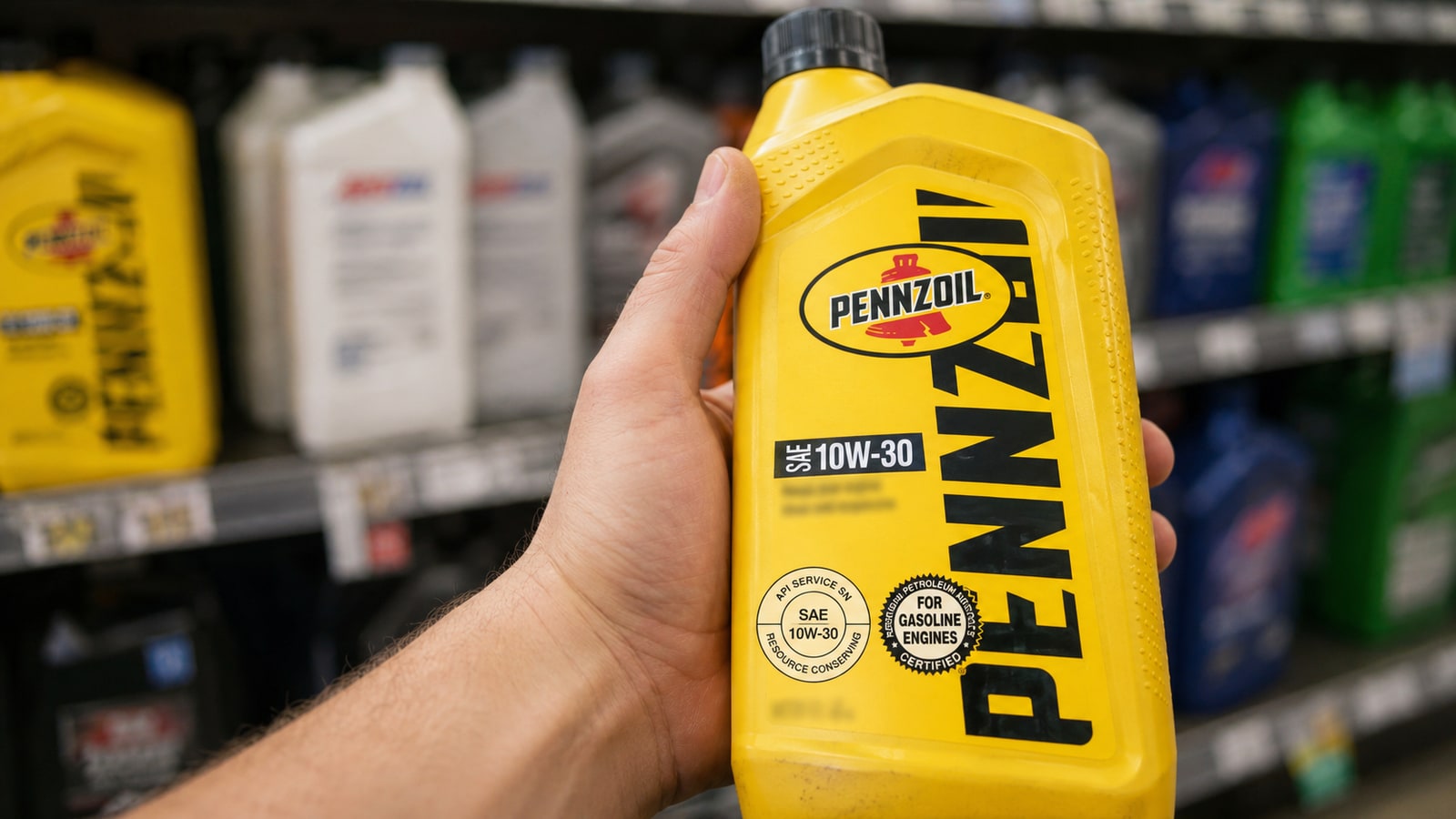
Every motor oil bottle carries three independent marks: the API Service Symbol (the "donut"), the API Certification Mark (the "starburst"), and the SAE viscosity grade. Reading all three together tells you whether the oil fits the engine before you commit to a case, drum, or tote. American Oil Wholesale (aoilw.com), our Hialeah-based wholesale distributor, carries motor oil across API service categories and a broad range of SAE viscosity grades, so once you know what the marks mean, ordering the right product in the right package is straightforward.
If you run an auto shop or fleet in South Florida, stocking the wrong service category is not a labeling technicality: it can void an engine warranty and leave you absorbing the cost. This guide explains what each mark tells you, how the three work together, and what a South Florida shop should look for when building a wholesale oil shelf.
The API Service Symbol (the "donut")
The API Service Symbol is the circular, donut-shaped mark printed on every API-certified motor oil bottle. Read each of its three sections separately.
- Top half: the service category. "SQ" is the current standard for gasoline engines, introduced in March 2025 alongside ILSAC GF-7 (API). The prior category, "SP," launched in 2020 with ILSAC GF-6 and remains widely found on-shelf; SQ and GF-7 are backward compatible with engines that previously called for SP. Older gasoline categories include SN Plus, SN, and SM. For heavy-duty diesel engines, look for "CK-4" (the backward-compatible current category) or "FA-4" (a lower-viscosity category for specific newer on-highway diesel engines that specify it). The category tells you the engine type the oil was designed for.
- Center: the SAE viscosity grade. The number here, such as "5W-30" or "15W-40," is the viscosity grade defined by the SAE J300 standard (SAE International).
- Bottom half: "Energy Conserving" (if applicable). This designation appears on gasoline engine oils meeting fuel-economy requirements. Diesel categories do not carry this designation.
A common stocking mistake is reading only the center grade and ordering by viscosity alone. A "5W-30" can be API SQ (or SP) for a gasoline engine or API CK-4 for a heavy-duty diesel, and putting the wrong one in an engine takes it outside the maker's specification. Always confirm the service category in the top half before you order. Our lubricant cross-reference chart maps common name-brand equivalents by API category and SAE grade so you can verify the right product quickly.
The API Certification Mark (the "starburst")
The API Certification Mark is the starburst-shaped symbol that certifies a motor oil has been independently tested against the current ILSAC standard for gasoline engines. ILSAC GF-7A certified oils carry the starburst. ILSAC GF-7B certified oils carry a separate API certification mark that distinguishes the 0W-16 track from the backward-compatible grades. Diesel oils carry neither mark, because ILSAC standards cover only gasoline categories.
ILSAC GF-7 is the current gasoline engine oil performance standard, first licensed in March 2025 (API). It replaced GF-6, which had replaced GF-5 in 2020, and splits into two tracks:
- ILSAC GF-7A covers the most common passenger-car viscosity grades, including 0W-20, 5W-20, 5W-30, and 10W-30. GF-7A is backward compatible with prior-generation GF-6A and GF-5 oils.
- ILSAC GF-7B covers only the 0W-16 viscosity grade and is backward compatible with GF-6B but not interchangeable with GF-6A-grade oils; 0W-16 is not a drop-in replacement for 0W-20 or 5W-20. Stock 0W-16 with GF-7B certification only for engines whose OEM manual specifically calls for that grade.
If the starburst is missing from a gasoline oil label, the product has not been independently certified against ILSAC requirements. Confirm the API service category and review the oil maker's technical data sheet before using it in a customer vehicle under warranty.
The SAE viscosity grade (SAE J300)
The SAE viscosity grade, defined by the SAE J300 standard (SAE International), tells you how the oil flows under operating temperatures. The grade is printed in the center of the API donut and on the front of the bottle.
For multigrade oils like 5W-30:
- The number before the "W" (W stands for winter) describes cold-start behavior at low temperatures: the lower the W-number, the better the oil pumps in extreme cold.
- The number after the hyphen describes kinematic viscosity at 100°C (212°F), the operating temperature that governs film strength under load.
South Florida context: Miami-Dade's year-round warm temperatures mean the W-grade cold-start rating is rarely the binding constraint here. All common W-grades pump freely at the temperatures the region sees even in January. What matters for a South Florida engine is the operating viscosity (the number after the hyphen) and the service category, since year-round heat puts engines under sustained thermal load rather than cold-start stress. A shop moving its top-volume grade from quart cases to a 55-gallon drum gets 220 quarts per drum (55 gal x 4 qt/gal) at a lower per-quart cost, and the SAE grade and service category on every quart stay identical regardless of package size.
Reading all three marks together
Treat the three marks as a checklist before every order:
- Confirm the service category in the top half of the donut: SQ for current gasoline (SP for prior-generation; both are widely on-shelf and SQ is backward compatible), CK-4 for current heavy-duty diesel.
- Check the SAE grade in the center against the OEM manual specification.
- Look for the ILSAC starburst (GF-7A grades) or the GF-7B certification mark (0W-16) if you are stocking for gasoline engines; either confirms independent certification against the current GF-7 standard.
A label reading "API SQ / SAE 5W-30" with a starburst is a certified, current-spec gasoline engine oil in a mid-weight grade; a label showing "API SP / SAE 5W-30" is the prior generation, widely available; SQ is backward compatible with engines that specified SP, so shops can run SQ-spec oil in both. A label reading "API CK-4 / SAE 15W-40" with no starburst is a heavy-duty diesel oil: the starburst is absent not because the oil failed a test, but because ILSAC starburst certification does not apply to diesel categories. Stocking one in the other application goes outside the engine maker's specification regardless of the SAE grade printed on both labels.
What this means for a South Florida wholesale shelf
South Florida is an active market for Japanese, Korean, and European passenger cars, plus an active commercial fleet sector. Modern passenger cars commonly specify API SQ as the current category; the OEM manual sets the exact grade, with 0W-20, 5W-20, and 5W-30 among the GF-7A grades the starburst confirms. Some Japanese and Korean passenger-car models require 0W-16, which needs a GF-7B-certified oil stocked separately; 0W-16 is not interchangeable with 0W-20.
For a shop serving a mixed South Florida bay, a wholesale starting shelf typically covers 0W-20, 5W-20, 5W-30, and 0W-16 for gasoline engines, plus API CK-4 15W-40 for any diesel vehicles. American Oil stocks all of these grades across multiple brands and house lines, available on a single wholesale account with local delivery across Miami-Dade, Broward, and Palm Beach counties; confirm availability at time of order. Our reps can match the right API category and ILSAC track to your actual vehicle mix and recommend whether to stock by the case for lower-volume grades or by the drum for top-sellers.
The same API and ILSAC marks govern the Caribbean and Latin American export market. When we ship drums of API-certified motor oil to resellers throughout the Dominican Republic, Haiti, Jamaica, and across the region, the marks on every bottle carry the same meaning they do in a Hialeah bay: an independent certification that the oil meets the current OEM performance standard.
Open a wholesale account to stock every mark your bays need
Request a quote at aoilw.com/quote and our reps will match the right API service category, ILSAC track, and SAE grade to your vehicle mix, then size the order by case, drum, or tote for local delivery across Miami-Dade, Broward, and Palm Beach counties; confirm availability at time of order. We work in English and Spanish and can confirm the right specification for every engine you service.
Sources
- American Petroleum Institute (API), Engine Oil Service Symbols and Certification Marks. https://www.api.org/products-and-services/engine-oil
- SAE International, SAE J300 Engine Oil Viscosity Classification. https://www.sae.org