
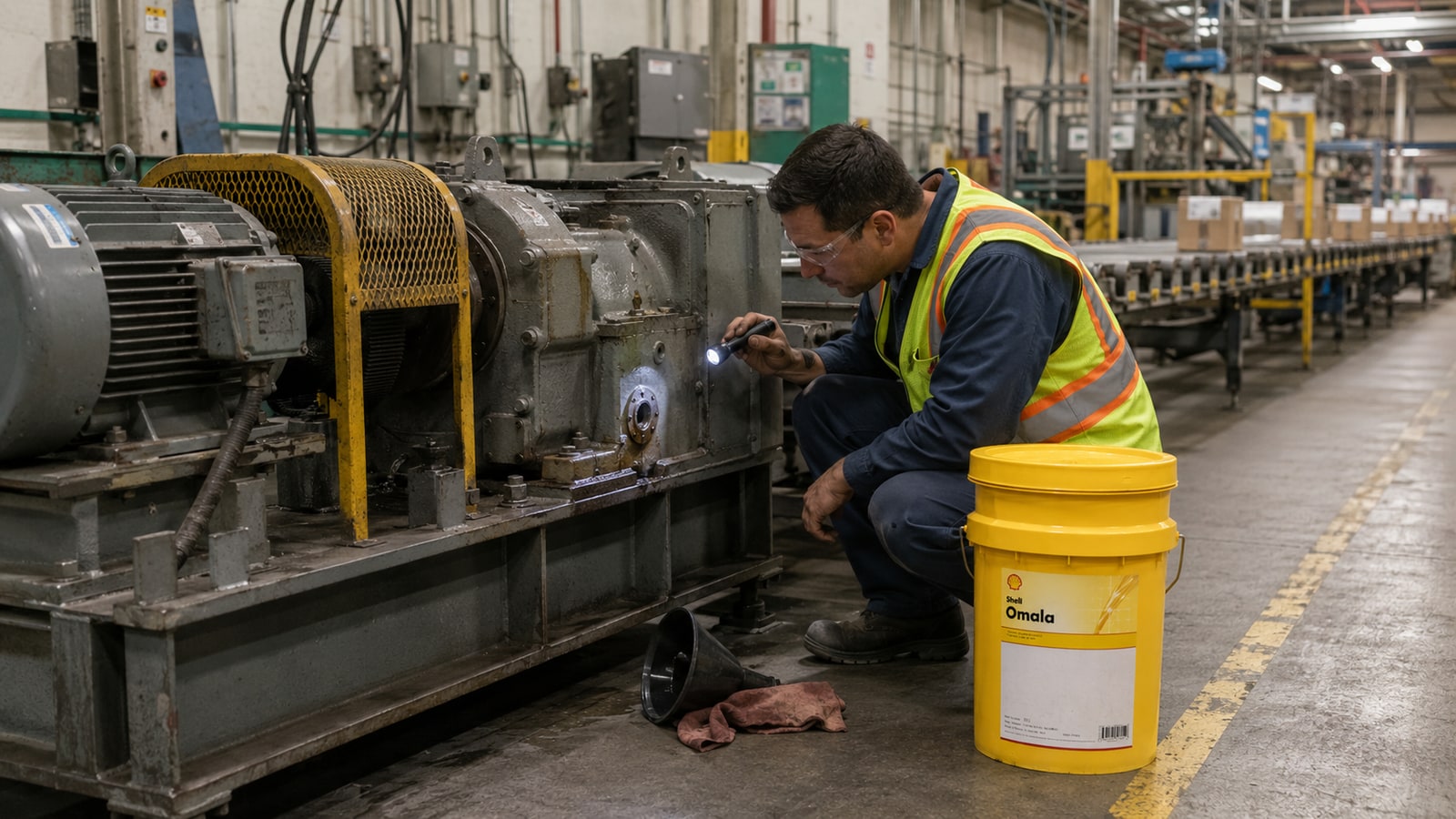
Industrial gear oil for enclosed gearboxes, including conveyor drives, speed reducers, mixers, and pump drives, is graded by ISO viscosity grade (VG) and classified under ISO 6743-6, not by the API GL rating system used for automotive differentials and manual gearboxes. The most common grades for South Florida warehouse, distribution center, and light manufacturing applications are ISO VG 220, VG 320, and VG 460, selected by the gear geometry, load, pitch line velocity, and operating temperature specified on the equipment nameplate or in the OEM reducer manual. At American Oil Wholesale, a family-owned Hialeah distributor, we supply industrial operations with these grades on the same wholesale account as hydraulic fluid, motor oil, and grease.
If you manage a South Florida warehouse or distribution center, the gear reducers and conveyor drives running your material handling systems have a lubrication spec on the nameplate, and that spec is almost always an ISO VG grade. Using a GL-5 automotive gear oil, or the wrong VG grade, can mean oxidation, foaming, or accelerated wear because the wrong product was never formulated for that application. This guide covers how industrial gear oil is classified, how to select the right VG grade, how South Florida operating conditions affect that selection, and how to stock it on one wholesale account.
ISO VG industrial gear oil vs API GL automotive gear oil
The two systems are designed for different applications and are not substitutes for each other. API GL-rated gear oils (GL-4, GL-5) are designed for automotive hypoid differentials, limited-slip units, and synchronized manual gearboxes operating under high-sliding loads at variable speeds. The GL rating describes the extreme-pressure additive performance level required by that specific contact geometry; our lubricant cross-reference chart covers those GL-5 automotive equivalents.
ISO VG industrial gear oil (ISO 6743-6) is designed for enclosed, fixed-ratio parallel-shaft gearboxes, including helical, spur, herringbone, and bevel gear reducers, running at steady loads and speeds without the hypoid sliding geometry that drives GL additive requirements. The ISO 6743-6 classification uses letter codes to describe performance level:
- CKB: oxidation-inhibited, anti-rust, anti-corrosion oil without extreme-pressure additives. Suitable for lightly loaded enclosed gears.
- CKC: CKB performance plus extreme-pressure additives. The standard type for most general industrial enclosed gear drives, including conveyor reducers, general-purpose parallel-shaft units, and material handling drives.
- CKD: CKC performance plus micropitting resistance, the key additional requirement per ISO 12925-1, for higher-load and elevated-temperature applications.
- CKE: formulated for worm gear drives, which require a fatty-acid-based additive system because bronze worm wheels react differently to the sulfur-phosphorus EP chemistry used in CKC and CKD oils.
For most warehouse conveyors, parallel-shaft speed reducers, and general material-handling gearboxes, the required type is CKC or CKD, confirmed on the OEM nameplate or in the reducer's lubrication specification sheet. Worm gear reducers, common in conveyor take-up units and smaller drive stations, require the CKE type.
How the ISO VG number defines the grade
The ISO viscosity grade number is the oil's nominal kinematic viscosity at 40°C in mm²/s, as defined by ISO 3448. ISO VG 220 is an oil with a nominal kinematic viscosity of 220 mm²/s at 40°C, within the ISO 3448 tolerance band of 198 to 242 mm²/s (±10%). VG 320 is 320 mm²/s at 40°C (tolerance: 288 to 352 mm²/s). VG 460 is 460 mm²/s at 40°C (tolerance: 414 to 506 mm²/s). A higher VG number means heavier oil that flows more slowly and maintains a thicker film under load and heat.
ANSI/AGMA 9005-F16 (Industrial Gear Lubrication), the American Gear Manufacturers Association standard covering lubricant selection for industrial gear drives, maps VG grade selection to gear drive parameters including pitch line velocity, operating temperature, and gear geometry. The general principle: slower, heavier-loaded, and higher-temperature applications call for a higher VG grade; faster, lighter-loaded, or lower-temperature applications call for a lower VG grade. Always defer to the OEM nameplate grade first; ANSI/AGMA 9005-F16 is the reference when the nameplate is missing or illegible.
The three most common grades in South Florida warehouse and industrial maintenance programs:
- ISO VG 220: the standard grade for most light-to-moderate duty helical and parallel-shaft enclosed gear reducers running at moderate pitch line velocity and load. Many OEM reducer manufacturers specify VG 220 as the baseline grade for their standard units operating within the nameplate temperature range. In an EP formulation, this is the lane of a product like Shell Omala S2 GX 220 Industrial Gear Oil, which we stock in 5-gallon pails.
- ISO VG 320: a step heavier, specified for moderate-to-heavy duty reducers, slower pitch line velocities, or higher ambient operating temperatures. The most common upgrade from VG 220 when the operating environment runs warmer than the OEM's baseline reference.
- ISO VG 460: the heavy grade for slow, heavily loaded gears, including large agitator drives, heavy conveyor head drives, and industrial mixer gearboxes operating at low speed under high torque.
Where the OEM specifies a rust-and-oxidation inhibited circulating oil rather than an EP gear oil, the same ISO VG logic applies: TekStar R&O AW Hydraulic Oil ISO 220, ISO 320, and ISO 460 cover those heavier R&O anti-wear applications in pails, drums, and totes. Always match the type designation on the nameplate, not just the VG number.
South Florida warehouse conditions and VG selection
South Florida's year-round heat is a real factor in industrial gear oil selection. Miami-Dade County's average July high reaches 91°F (33°C) per NOAA climate normals for Miami International Airport, and enclosed gearbox sumps in unconditioned warehouse space run well above ambient during sustained operation, past the 40°C reference point in ISO VG grade specifications. Kinematic viscosity decreases as temperature rises, so an oil specified at ISO VG 220 for a 40°C reference gearbox may thin below the protective film threshold under those conditions.
Facilities in the Doral, Hialeah, and Medley distribution corridor run belt conveyors, bucket elevators, screw feeders, and chain drives in unconditioned or partially conditioned space. When the gearbox operating temperature exceeds the OEM's reference temperature, the standard approach per ANSI/AGMA 9005-F16 is to consult the reducer manufacturer's temperature-correction chart and step up one VG grade if needed, for example from VG 220 to VG 320. Confirm the grade change with the OEM's lubrication specification before switching. If your facility consistently runs above the top of the nameplate ambient range in summer, that one-grade bump is a low-cost maintenance decision compared to a bearing or gear failure.
For Caribbean and Latin American plants, the same ISO 3448 VG system and the same ANSI/AGMA 9005-F16 recommendations apply across markets, so the grades that protect a Medley warehouse protect a facility in Jamaica or the Dominican Republic too. We sell EXW Miami for export: you order (the $1,250 minimum export order applies), we palletize and load your consolidator's truck at our Hialeah dock with the paperwork ready.
Pail or drum: how to stock industrial gear oil
Industrial gearboxes have longer service intervals than engine oil, with most enclosed gear drives serviced annually or at OEM-specified operating-hour intervals, so a facility's annual gear oil consumption is more moderate than its motor oil volume. Match the container to the program:
- Pail (5 gallons, 20 quarts): the right tier for a single gearbox or for maintenance programs covering only one or two reducer units per service cycle. EP industrial gear oil such as Shell Omala S2 GX 220 Industrial Gear Oil ships in this format.
- Drum (55 gallons): the right tier for a facility with multiple drives on a managed preventive-maintenance schedule. A 55-gallon drum holds the equivalent of 11 five-gallon pails (55 ÷ 5 = 11), so a program that fills 11 gearboxes per cycle goes from handling 11 separate containers to one drum. The TekStar R&O AW line ships in pails, drums, and 275-gallon totes.
Stocking gear lubricants on one American Oil account, alongside hydraulic fluid, motor oil, coolant, DEF, and grease, means a single delivery and a single invoice for the full maintenance program instead of multiple supplier relationships. The $250 minimum domestic order makes it practical to add a pail or two to a regular fluid delivery. Our weekly routes cover the tri-county area, from West Palm Beach down to Homestead; see our South Florida delivery areas.
Stock the right industrial gear oil on one account
The right industrial gear oil is the ISO VG grade and ISO 6743-6 type printed on the gearbox nameplate or in the OEM service manual, bought in the container size that matches your preventive-maintenance cycle. Tell us the grades you need, the number of gearboxes on your PM schedule, and your annual consumption estimate, and our reps, in English or Spanish, will match the products and container tiers to your program. Request a wholesale quote and get your maintenance fluids on one invoice and one delivery.