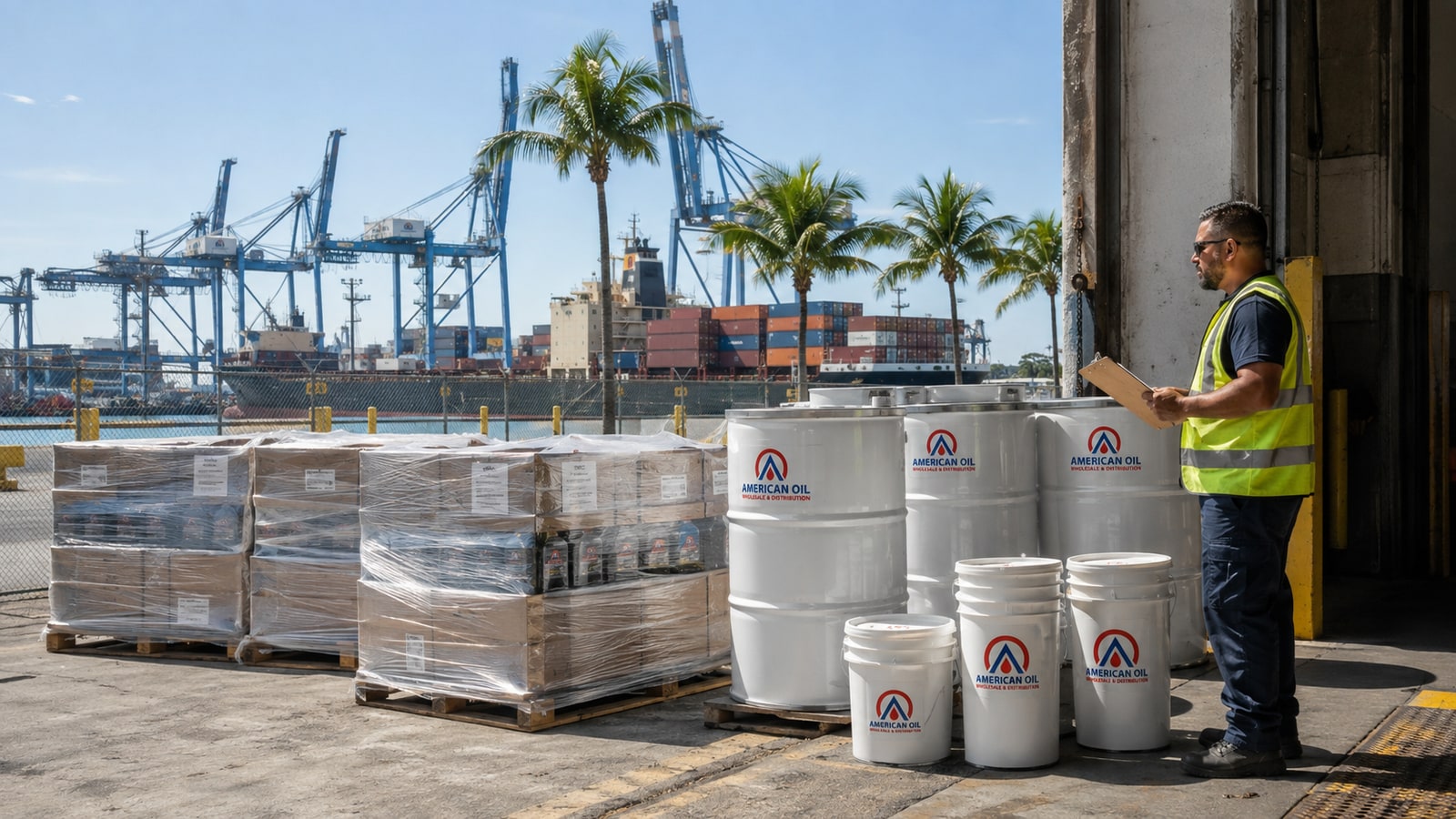
For most Caribbean and Latin American lubricant importers buying from Miami, EXW (Ex Works) is the better fit. Your freight consolidator picks up your order at our Hialeah warehouse and, from that point, you control the full freight chain to your destination port. EXW also lets you combine lubricants with goods from other Miami-area suppliers in one container, which is the consolidation model most Caribbean buyers use to keep per-unit freight cost in line. Our export program at aoilw.com starts at the $1,250 minimum export order.
FOB (Free On Board) makes sense when the seller handles export clearance and vessel loading. In practice, most Miami lubricant distributors are not licensed freight forwarders, so true FOB service is less common on this trade lane than buyers sometimes expect.
What Each Incoterm Means
The ICC's Incoterms 2020 framework defines 11 standard rules governing where risk and cost pass from seller to buyer in international trade (International Chamber of Commerce, Incoterms 2020, via U.S. ITA). Three come up most often for Caribbean and Latin American lubricant shipments from Miami:
| Term | Risk Passes at | Export Clearance | Best Use Case |
|---|---|---|---|
| EXW (Ex Works) | Seller's premises, at pickup | Buyer | Mixed-supplier loads; buyer has consolidator |
| FOB (Free On Board) | Goods loaded on named vessel | Seller | Seller manages loading and export clearance |
| FCA (Free Carrier) | Named carrier or terminal | Seller | Containerized cargo; ICC's preferred alternative to FOB |
How EXW Works from Our Hialeah Warehouse
Under EXW, your consolidator or freight forwarder schedules a pickup at our Hialeah warehouse. Your driver loads the order, drives to their freight terminal, and consolidates it with other Miami pickups bound for the same destination port. Your team or forwarder files the Electronic Export Information (EEI) through the Automated Export System (AES) and handles all export paperwork. Risk and cost transfer the moment your driver leaves our dock.
The practical advantage for Caribbean and Latin American buyers is the consolidation model. A single truck run can pick up lubricants from us, make additional stops at other Miami-area suppliers, and arrive at the freight terminal with a full mixed load. One container, one ocean booking, freight cost spread across all the goods in the box.
We ship motor oil, gear oil, hydraulic fluid, and grease in cases, pails, drums, or totes, and DEF in 2.5-gallon jug cases or drums, all on a single invoice. Caribbean markets we regularly serve include the Dominican Republic, Trinidad and Tobago, and Jamaica; for a full view of the destinations we cover, see our markets page.
How FOB Works on the Miami Trade Lane
FOB puts the seller in charge through vessel loading. The seller delivers goods to the named port, clears export, and loads them onto your vessel. Risk transfers once cargo is on board the ship.
In the Miami lubricant wholesale market, true FOB pricing is uncommon. Not every distributor holds the freight forwarding licenses to move cargo to the port and coordinate vessel loading. When a supplier quotes FOB Miami, confirm that the price includes export clearance and inland freight from their facility to the port, because those are real costs that show up somewhere in the deal.
When EXW Is the Better Choice for Your Operation
EXW fits your import model when:
- You have a freight consolidator already. If a consolidator is already running Miami pickups for you, adding a lubricant stop to their route is straightforward. They know the terminals, they carry the chassis, and your per-unit freight cost drops when the container is full.
- You source from more than one Miami supplier. EXW lets you pick up from American Oil and other vendors in the same truck run. FOB fixes you to one seller's loading schedule.
- You want full freight cost visibility. Under EXW you receive one invoice for goods and a separate one for freight, terminal, and ocean. No bundled costs, no hidden markups.
- Your shipments reach the export minimum. Our export program requires a $1,250 minimum export order. Most Caribbean and Latin American buyers reach that threshold on motor oil and DEF alone.
When FOB Might Make More Sense
FOB is worth considering when:
- You are new to importing from Miami and have not yet established a consolidator relationship.
- Your seller has a carrier relationship and an all-in FOB price that is lower than what you would pay for EXW goods plus your own freight and EEI filing costs.
- You need the simplicity of one contact managing the shipment from the seller's dock to the vessel.
If you are building toward the EXW consolidation model, the article on our EXW export guide walks through the three-party handoff in detail.
A Note on FCA
Incoterms 2020 added a buyer-instructs-bill-of-lading clause to FCA and positions it as the preferred alternative to FOB for containerized cargo. Under FCA, risk transfers at the named freight terminal rather than on the vessel itself, which better reflects how containerized goods actually move. FCA is not yet standard practice in most Caribbean lubricant trade, but if your freight forwarder raises it, it is a well-supported and ICC-recommended option.
Open a Wholesale Export Account
To open a wholesale export trade account, visit aoilw.com/quote. Our team at (305) 825-2788 or WhatsApp (786) 651-6216 will confirm your EXW terms, send a proforma invoice, and coordinate pickup timing with your consolidator.
Sources
- International Chamber of Commerce. Incoterms 2020. Via U.S. International Trade Administration. trade.gov/know-your-incoterms
- U.S. International Trade Administration. Pro Forma Invoice. trade.gov/pro-forma-invoice